Tuesday, May 20, 2008

Lives and Loves of Artists & their Nude Models


The Luncheon on the Grass (1862 - 1863) by Édouard Manet (left photo).

Published in Manila Bulletin, Lifestyle Section (Art), Page F 1-2, May 19, 2008

The most controversial and, perhaps, the greatest work of a French painter Édouard Manet is “Le déjeuner sur l'herbe” (The Luncheon on the Grass), executed between 1862 and 1863 on a huge 81.9 × 104.5” canvas. Set against the verdant landscape, a naked woman, as if consciously posing on her side, is seated with two fully dressed men. At a short distance is a chemise-wearing woman bathing on a still-flowing stream.

The painting shocked the French public when it was first exhibited at Salon des Refusés in 1863. It was not really the female nudity that sparked the controversy, but the indecent exposure of a naked woman amid the fully dressed men.

Equally provocative is how Manet used two models for his female nude: Suzanne Leenhoff (his wife) and Victorine Meurent (his favorite model). A closer look on the painting, one can detect a slightly asymmetrical proportion between the woman’s head and her naked body. The artist uses Meurent’s youthful face while the hefty body belongs to his wife, Leenhoff.

Was the artist fantasizing Meurent’s face to be his wife’s while retaining the latter’s body, or was it his clever way of immortalizing Leenhoff’s naked body on the painting?

THE LIVES AND LOVES OF ARTISTS AND MODELS

In his recent coffee-table book “The Lives and Loves of Artists and Models” (320 pages, 243 illustrations), Manuel “Manny” D. Duldulao pays tribute to the models, whose identities are relatively unknown, and extols their vital role in the artists’ lives and creations. He travels back and forth in time by exploring the attitude and concept of nude art and the story behind the unflinching relationships between the artists and their respective models.

The most interesting topics are the historical accounts of nude models like a Greek farm girl named Phyrne (350 B.C.) to Sandro Botticelli’s on “The Birth of Venus” (1484) during the Renaissance period, Leonardo da Vinci's controversial “Mona Lisa” (1503) to Salvador Dali's complex relationship with Gala and her lovers?

Reading the book is like journeying back to the lives of artists from ancient to medieval, from classical period to postmodern era. It is a compendium of love stories and sinuous liaisons woven with romance, scandal, intrigue, betrayal and death of the creators and their models.

Ironically, in the local art scene, the author is discreet to explore the private relationships of Filipino artists and their models. Instead, he zeroed in on the development of nude art in the Philippines from 1930s through 1970s and from 1980s onwards.

The narrative account of the book is elegantly written, sensually provocative and, at times, indulgent. The author, in a more personal approach, has deviated from his objective and straightforward narrative, which is characteristic of his previous books, by occasionally injecting his sentiment: a quasi-narrative of his thoughts and feelings in between paragraphs and chapters.

A TOYM awardee (Ten Outstanding Young Men) in 1973, Duldulao’s passion, as art writer and historian, seems to be inexhaustible after several decades of chronicling the Philippine art movements and activities.

As a self-made man, he is the only non-academe art historian who has extensively written more than 20 coffee-table books in the fields of arts and culture and has, recently, launched a scholarly reference book (volumes I & II) on the history and development of Philippine law and judicial system. His colossal achievement as author and writer is beyond compare among his contemporaries and the new generations of art writers.

THE DEVELOPMENT OF NUDE ART IN THE PHILIPPINES

The following conversation with the author in January 10, 2005 was a brief glimpse of “The Lives and Loves of Artists and Models” prior to its final publication and launching in 2007.

D.C. SILLADA:
What is the main concept of your book on Nude Art in the Philippines?

MANNY DULDULAO:
The main objective of the book, “The Lives and Loves of Artists and Models”, is to place Philippine art in the context of universal aesthetics. That is the reason why I developed the book by showing masterpieces of nude paintings around the world from Spain to Parish to New York and, then, juxtapose them in the context of Philippine art movement.

All of the paintings that I am featuring in the book are full-blown artworks in the respective style of the Filipino artists. I don’t feature sketches or drawings because we cannot elevate Philippine art into a universal level if we are going to show minor pieces.

Nude painting in the Philippines is relatively a recent activity. It only came out in the 1980s and before that, from the 1930s to 1950s, there were not much movement especially in the academe like the University of the Philippines because they could hardly get a Filipina model to pose for the Fine Arts students.

D.C. SILLADA: What is the attitude and concept of Nude Art amid our conservative culture from 1930s through 1970s and 1980s onwards?

MANNY DULDULAO:
Nude paintings in 1950s and 1960s, I would say, were practically academic. They were for studies of human anatomy along the lines of academic requirement, and not for the purposes of gallery exhibitions.

It was only in the 1970s with the organization of the Casa de Oro Group, which is currently known as the Saturday Group, under Alfredo Roces, Hernando Ocampo and Cesar Legaspi, when the nude as an art form began to emerge. Other artists took it from there like the group of Ernie Tagle; they took serious undertaking of giving the nude art form its due in the Philippine art movement.
I would, therefore, say that the flowering of the nude as an art form by itself began in the 1970s and blossomed around 1978 to 1979 and, then, started to have a heavy solid footing in the Philippine art market around the early 1980s.

Now, of course, anything goes... In fact, you can find nude session almost everyday and the artists are no longer looking at it as a form of exercise, but simply as an exploration of art form.

D.C. SILLADA: The Filipina nude models: how they respond to exposing their naked bodies in front of the artists, considering our conservative culture toward nudity?

MANNY DULDULAO:
In the 1950s, you could count on your fingers the girls who were posing in the nude, and they were mostly posing in academic classes like UP. However, it was only during 1970s that modelling became a profession, and one of the legendary pioneers is Nellie Sta. Maria.

When the girls realized that it was a serious undertaking and they could earn some good money in the process, many of them started modelling professionally for a moderate fee. Consequently, they were getting regular assignments especially with the group of Tagle, and they were common girls, not in the entertainment profession.

The girls were mostly students who put their trust (in) the integrity of the artists. One of them was a niece of the late art critic Lorna Revilla Montilla. She was fondly called Inday. One time, the model that they were waiting did not arrive so Lorna told her niece “O, Inday ikaw na lang ang mag-pose...”

It was the beginning of her modelling career that eventually prospered. Now, some girls took it as a profession: they are no longer embarrassed disrobing in front of the artists.

Today, Filipina movie stars pick up the modelling stints, so you can count on them as regular sitters. Girls like Tracey Torres, Julia Lopez, Rosanna Roces, Andrea del Rosario, Katya Santos, Honey Miller, the controversial Keana Reeves and Rose Valencia, they all posed in the nude sessions.

D.C. SILLADA: What is your main thrust in the book in relation to the artists and their nude models?

MANNY DULDULAO:
After reading several literatures on nudes, I found out that art authors and historians concentrated on the human body as a source of art form. What I did with my book, I researched on the lives of nude models.

Like, for instance, the famous painting of Sandro Botticelli titled “The Rising of Venus”; I was able to gather enough information as to who the model was and the family where she belonged to. Likewise, the model of Édouard Manet and his controversial painting “The Luncheon on the Grass”: who was she and what was her name?

These are essentially the main thrusts of my book: the artists, the models and their symbiotic relationships that create a compelling history and developments of nude art from ancient time to postmodern period.


© Danny Castillones Sillada
_______________________________

Above Photos: (1) The Empty Frame (2006) by Fidel Sarmiento,(2) Blush (2004) by Andi Cubi, (3) Bathing Sisters (2003) by Baltazar Fornaliza, (4) Ripened Womb (1999)by Danny C. Sillada.

Saturday, May 17, 2008

A Tribute to a Mindanaoan Painter (The Art of Max Adlao)


“I put my heart and my soul into my art, and have lost my mind in the process…”
- Vincent Van Gogh
Published at Manila Bullen, Lifestyle Section (Art), May 5, 2008

The summer wind is drifting through the lattice window of Max Adlao’s rented apartment in Cavite. The flapping of curtains, the creaking bed and the songs of migrating birds are the only sounds that he can hear in his quiescent room.

Across his bed is an empty canvas leaning on a paint-splotched easel. Though the canvas has remained untouched for some time now, the aging artist is patiently waiting for the right moment to paint the last masterpiece of his ebbing existence.

Whatever the price to become a Filipino artist and to dedicate an entire life creating beauty, forms and colors on canvas, Max Adlao, amid his recurring illness and destitution, has already contributed the finest feats of his artistic career, undeterred and unnoticed.

MAX ADLAO’S LAUGHING CHRIST
Some years ago, I met the man. Although, he was already in the late part of his existence yet, he was still full of vigor with an impish sense of humor. He was teeming with life then, full of dreams and madly in love with a young pretty wife half of his age.

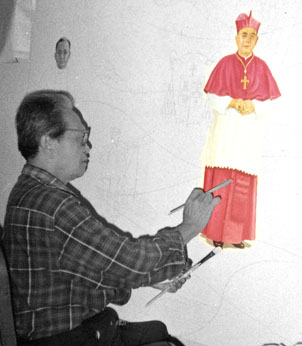
I had the honor of working with him in 1996 when a good friend, Archbishop Tom Yalong, D.D., then auxiliary bishop of the Archdiocese of Manila, commissioned me to paint a 6 X 10 feet mural in commemoration of the four hundred years since the Christianization of the Philippines.

I was struggling then -- and I still am -- as a full-time painter fresh from the corporate world where I worked as a junior executive in an HMO company in Makati. Despite our age -- or if I may say, mood gap -- he worked patiently with me like a loyal servant with his master.


6 X 10 feet Mural, 1996. Oil on Canvas by Danny Sillada & Max Adlao.
Permanently installed at the Roman Catholic Office, Arzobispado, Intramuros, Manila.

Occasionally, he would correct my preliminary sketches on a huge canvas in my absence without saying a single word. At times, when we were so engrossed painting together, he would suddenly crack sidesplitting jokes to soften the intense atmosphere. He had always a way of making a dull moment funny between us and, like a father, he would interject his opinion in a manner that I won’t be offended during our conversation.

For instance, in one of our strenuous routines painting together, he told me: “Danny, St. Lorenzo Ruiz will kick you out in heaven if you portray him with shorter legs on this mural…”

We looked at each other for a while and, then, burst into laughter. Our laughter receded temporarily and then continued with the same pattern until we parted ways from a hard day’s work. Oblivious to him, I was amused inside as though my father was alive again in his presence, guiding me through my oversight and blunder.

At another instance, I came late to our working studio at the third floor of the Arzobispado De Manila building in Intramuros. I was flabbergasted to discover that my sketch of risen Christ was already painted over, and the image was looking straight through my eyes, laughing!

I was petrified in disbelief! My original sketch of Christ was not laughing or smiling at all. I was supposed to paint the Risen Christ with my original drawing to portray Him in a somber mood with opaque color. I did not speak to Max Adlao that day.

At nightfall, after he left with his wife off to his rented apartment in Cavite, I repainted his laughing Christ with my original concept on a wet on wet technique until I finished the figure at three o’clock in the morning.

No one knows that secret until today: that behind my portrayal of gloomy Christ on that huge mural is Max Adlao’s happy and laughing Christ. I would like to think and believe, though, that our Christ is the same, albeit mine is a lonely one.


Detail of Risen Christ by Danny Sillada, 1996.Behind this portrait is a laughing Christ of Max Adlao
MAX ADLAO’S ARTISTIC JOURNEY

Max Adlao started his artistic career that spanned the late 1950s through the 1980s; he was a cinema billboard artist. He was so good at his craft that he was one of the most sought-after painters in his time from cinema billboards to the propaganda government murals at the heart of Durian City, the city of Davao.

During his spare time, he would settle in his small studio to paint his World War II memoirs. The haunting images of the Japanese and the American warplanes, flying bombs and bullets, tanks and dead soldiers were oozing out from his small canvases.

In 1988, after spending for more than three decades as a billboard artist, he was given a big break when the Central Bank of Davao gave him a one-man show highlighting his portrayal of the countryside sceneries and the early Davaoeño customs and traditions.

The exhibition was such a success that he eventually earned the respect of his fellow Davaoeño artists and art critics alike, and was hailed as the Amorsolo of Mindanao. However, despite the accolades, he had wished that his beloved wife were alive to share his joys and success as a painter.

Then came 1992, the turning point of Max Adlao’s artistic career: his daughter and son-in-law invited him to spend a vacation in Germany.

FILIPINO ART ON THE STREETS OF GERMAN SOIL

In autumn of 1992, Max Adlao arrived in Germany and saw a completely different world, the grandeur of old and modern houses and buildings, and the diverse art and culture of German people.

However, after staying in Germany for a week, he was bored staring at the television screen watching shows in a language that he could not understand. His routine was to eat, sleep and wake up, a rather arduous activity than putting his mind and body in painting.

Jaded and restless, Max Adlao began to wander on the streets of German soil and there, he eventually found a language that everyone understands – the language of his art. With paint, easel and brush in his hands, he started to sketch and paint the passersby, the mood and the environment of German people.

In such a short period, Adlao became the first Filipino street artist capturing the hearts of German enthusiasts and collectors with his almost ritualistic on-the-spot portraiture and plein air paintings. He mesmerized the curious bystanders and dilettantes with his riveting aesthetic performance and, eventually, gained students and followers on the street.

Despite his newfound fame, Adlao felt an indescribable void inside as if part of his life were absent and missing. He was searching for something that would fill the emptiness of his existence, but he didn’t know what it was.
FINDING THE LOVE OF HIS LIFE
After his brief stint in Germany, he went home and stayed for a while in Manila hoping to find himself in the art capital of the Philippines. This time, his emptiness worsened that he decided to make another journey back to his hometown in Davao. Unknown to him, he was about to meet the second love of his life, a young Davaoeña named Shirley.

In 1993, Max Adlao was no longer desolate or alone. Together with his newfound love, Shirley, they both sailed again, leaving the Land of Promise, to start a new life in Manila. With the help of his paizano artist, Lovino, he was introduced to the owner of Genesis Gallery, who bought the first batch of his paintings.

After some time, he became one of the resident artists of Heritage Gallery under the kind patronage of Atty. Mario Alcantara. Since then, he became active at the different group shows and other art activities in Metro Manila.

In 1996, he was one of the grand price winners at the national art competition, which was sponsored by the Supreme Court for the Philippine Judiciary centennial celebration.

In 2000, for almost a decade of his artistic career in Manila, he had his first one-man show under the sponsorship of Ayala Country Club in Alabang. It was, perhaps, the apex of Max Adlao’s life as octogenarian artist.

This time, however, he began to feel the descending thrust of his creative life due to his weak physical condition. Few months later, he suffered from a mild stroke that would put him in bed for a while.

Since then up to the present, Max Adlao suffered intermittent mild strokes that would later impair his sense of hearing and his capability to paint on canvas.


MY KIND OF ARTISTToday, whenever I think of Max Adlao, I would remember him as a rising moon in my darkened window. He is like a father, who once taught me how to fly a kite – the stronger the wind the higher it rises. He is my kind of artist, who does not know how to give up life even if the whole world were to give up on him.

And every time I remember my somber Christ, I would always think of Max Adlao’s happy and laughing Christ behind the mural that we once collaborated and brought into existence.
© Danny C. Sillada


Max Adlao on the Mural we once collaborated, 1996.
I would lay down sketches on the entire canvas and divide
among us the portions where we would feel at ease to paint.

Photo by Danny Sillada (c) 2005. Posted by
Hello

© Danny Castillones Sillada

Monday, May 12, 2008

The Poetic Revelation in Language and Culture: The Vision of Sonny Villafania


“Language is the blood of the soul into which thoughts run and out of which they grow.”
-- Oliver Wendell Holmes

Manila Bulletin (Lifestyle section, pp. F1-F2, May 12, 2008)

Poetry, according to a German philosopher Martin Heidegger, is the foundation of truth. As a foundation of truth, it employs aesthetic symbols to reveal realities that concern the historical, cultural and socio-political conditions of man in his society.

The use of metaphor or allegory, for instance, is a symbolic device to magnify the objective reality and establish a rational basis in understanding the truth.

As a foundation of truth, poetry reveals what is hidden in such a way that the general readers or public will know it, and the most effective tool to reveal such symbolic reality is the use of language and linguistic expression common to a particular culture and society.

One of the greatest poets who had achieved such magnificent feat is a British-Indian poet Rabindranath Tagore, whose poetry transformed, not only the lives of Bengali people, but also the Bengali literature and culture in the 19th and early 20th centuries.

Tagore’s poetry like the famous collection of Gitanjali (Song Offerings), which was translated into several languages, has been sang and spoken by the common Bengali people such as farmers, fishermen, the monks, the townsfolk and the intellectuals.

THE POETIC REVELATION OF SONNY VILLAFANIA
In the local Philippine literature, there is one visionary, who is about to achieve such poetic revelation to the common people in his region, a multi-awarded Pangasinan-born poet Santiago “Sonny” Villafania.

His remarkable achievement, in the standard of anlong tradition (Pangasinan Poetry), defies the conventional use of Filipino literary languages, which are English and Filipino, by creating a suite of highly structured sonnets and villanelles in his native lingua franca.

In his book 364-page “MALAGILION: Sonnets tan Villanelles”, one of his poems “Rekindled”, which is included among the collections of poems written in Pangasinan, Villafania takes the reader into a sensual journey of bucolic life that reflects his origin and culture.

“There is a rice-pounding song tonight playing…” he wrote in a simple introductory line, yet the imagery is filled with sensual meaning that is only decipherable among the ordinary people in his region.

The “rice-pounding song” evokes the rhythmic sound of pounded rice on lusong or wooden hollow echoing amid the rising moon and the silences of the night. One could imagine the smell, the sound and the taste of unripe rice being fried on a cauldron and then pounded to make them crunchy.

As the poem continued in the second paragraph, Villafania introduces and defines the rice-pounding not only as an ordinary activity, but also as a ritualistic gathering of young men and women to celebrate the offering to the goddess of earth and harvest.

The poet reveals the symbolic meaning of rice-pounding as offering and ritualistic celebration. In the same way, as he uses a subtle allegory to signify the fruition and harvest of poetry in his own native language. “They will hear me scream my poems of hunting…”, thus, says Villafania with magnificent force and passion in his native language.

THE ELEGANCE OF LANGUAGE AND ITS ACCESSIBILITY TO THE PEOPLE
There is something mysterious and magical in the language or any language for that matter, that only a poet could fashion, magnify and unveil its hidden message through a unique linguistic expression of symbols and meanings.

A poet is like a messenger and, at the same time, a shaman, who conjures up the spirits to magically transform the language with unassuming meaning and become the common source of understanding among those who write and speak about it.

A good poet lifts up the soul of his or her reader to the symbolic and metaphysical meaning of reality so that his message can be understood and applied by the common people in their daily lives.

In the first paragraph of Sonnet 158, for instance, Villafania mesmerizes his readers with the use of sound and the fluidity of language that even a non-Pangasinan could feel the sensual rhythm and elegance of written words:

Panon takan aroen Pinabli?
Ipetek ko man ira’y sonata
Anlongen ko man ira’y sonito
Ag iraya onkana anganko
Ed puson agto amta’y ondengel
Ed saray Dangoan na panangaro

--------------

“How can I love you, dear?/ Even if I sing these sonatas/ Even if I write these sonnets/ These are nothing it seems/ To a heart who knows not how to listen/ To the Songs of Love.”

Villafania addresses that concern with urgency in such a way that his particular readers do not only feel and understand his sentiments, but also live and speak about it. He is like a chameleon immersing and identifying himself with the anguish of his people by gathering them toward a common understanding of reality.

In a sense, Villafania is not only a visionary poet; he is a linguistic philosopher who codifies the origin of language and culture. He dissects and juxtaposes the literary tradition against the modern influences by dialectically infusing them with his poetic revelation of truth.

THE BOOK IN THE CONTEXT OF PHILIPPINE LITERATURE

To understand and appreciate the literary content of Villafania’s 364-page “MALAGILION: Sonnets tan Villanelles” as an important contribution to Philippine literature, it is noteworthy to discuss the derivation of title, the literary content, style and structure.

The book’s title “MALAGILION” is derived from “malapati” (dove), “agila” (eagle), and “lion” (lion), an allusion to the alter ego of a Filipino-American poet Jose Garcia Villa, who called himself as Doveglion (Dove Eagle Lion). A title of the poem from which the famous 20th century American poet E.E. Cummings wrote as a tribute to his Filipino friend, Jose Garcia Villa (Adventures IV 5; CP 904).

In essence, “Sonnet” is derived from “sonetto”, an Italian word for little song from which, in the 13th century, became a poem signifying fourteen lines following strict rhymes and specific procedures. It is fundamentally a dialectical structure with contrasting ideas, emotions, beliefs, images, etc., allowing the poet to resolve the tensions at the end of the poem.

The “villanelle”, on the other hand, is a poetic form originating from French literature and was employed in the English-language poetry in the 1800s. It is composed of two rhyming lines. The first and third lines of the first stanza are rhyming refrains that alternate as the third line in each successive stanza and form a couplet at the close. Composed of 19 lines, 5 tercets and 1 concluding quatrain, the villanelle is a complicated poetic form compared to sonnet.

One could imagine the regimen and artistry that Villafania underwent in conceiving and delivering his aesthetic creation, integrating these poetic forms in his own native language. The result of his painstaking labor is, impeccably, a magnificent work of art comparable to one of the Shakespearian opus in the 16th century.

Funded and published by the Philippine government’s Komisyon sa Wikang Filipino and Emilio Aguinaldo College, the book, among the very few written in native languages, is an ambitious attempt to bring literature to the masses, albeit a minute victory over the 170 Filipino languages spoken by the 80 million Filipino people inhabiting the 7,107 Philippine islands.

THE POET’S ADVOCAY

As a visionary Filipino poet, Villafania advocates the use of native language. He also encourages other writers to weave their craft in their native tongues so that literature will become accessible to the ordinary people, the same poetic vision, which the famous poet Tagore envisioned for his people. Villafania online publication of Dalityapi, for example, is a venue for all international and regional writers, who write in their respective languages.

To sum, in his regular column “The Breaking Signs” at Panorama Sunday magazine, a multi-awarded Filipino poet, writer and columnist Cirilo Bautista hailed Villafania’s book as “a source of rejoicing for readers of regional literatures... Villafania has created 300 sonnets and 50 villanelles in his own language that attempt to reflect the primacy of native culture and return the poet to the central stage of social life.”
© Danny Castillones Sillada
__________________________
Above photos: (1) Book Cover, (2) The Author, (3) Poster of the book.

Thursday, April 24, 2008

Weapons of Mass Destruction in Cesare & Jean Marie Syjuco’s Aesthetics


Weapons of Mass Destruction in
Cesare & Jean Marie Syjuco's Aesthetics
By Danny Castillones Sillada
“Por que también somos lo que hemos perdido...”
(Because we are also what we have lost…)
-Amores Perros, the movie

Published from Manila Bulletin, Page E-4, Monday, April 21, 2008

There is an air of intangible emptiness and, at the same time, that ineffable feeling of finding oneself in the midst of Cesare and Jean Marie Syjuco’s installation art. The more one goes deeper within the maze of their works, the more one feels that delicate part of human soul tiptoeing between the temporariness of time and eternity.

In their recent and first collaborative art exhibit titled “2 Minds, Many Madnesses”, after thirty years of their marriage, the couple virtually created an immense space on scanty walls and floor areas of the newly-opened Mag:net Gallery at The Columns in Ayala, Makati.

Congruent to the yin-yang principle of complimentary opposites, these two great avant-garde Filipino artists cradle their viewers with the intensity and the gentleness of their aesthetic creations.

AN ART BORN OUT OF A WOMAN

The birth of art from ancient civilization to the romantic and classical periods generally evolved and revolved around women. In fact, in the recent archaeological research about the ancient European civilization between 7000 and 3500 b.c., researchers found and unearthed some 30,000 sculptures of clay, marble, bone, copper and gold from 3,000 sites about the figure of goddesses, an indication of the ancient belief that the Creator of the world was Goddess.

The Filipino society, with its unique culture and tradition, is a society raised by mothers or women. Similar to the ancient European civilization, women have played a very important role in nurturing humanity in our post-modern society. And women, in general, are the artist’s muse and inspiration to create, the cradle of his dreams and the source of his creative power.

But what if a woman creates, what could be the source of her inspiration?

In her installation “I am the shadow of the waxwing slain by the false azure in the windowpane”, a quote from Vladimir Nabokov’s “Pale Fire”, Jean Marie Syjuco poignantly creates a sad picture of an orphaned egg snuggled on a tiny bird’s nest. The installation narrative tells a mother bird, after crashing through a glass window, fell and instantly died leaving its solitary egg untended.

Powerfully woven with realistic objects sans a dead bird, the theatrical composition of installation portrays the inevitable reality of death and abandonment. “Someday soon, I will depart from this world” said the artist to this writer with tears oozing from her eyes, “and I am worried for the eggs (children) that I will leave behind.”

In another installation, the artist tiptoes on the same trail of indefinable melancholy with her sentimental homage to a family friend, the artist-poet-writer Sid Gomez Hildawa, who recently passed away.

Jean Marie uses the premonitory last poem of Hildawa, which he wrote shortly before he died. She portrayed an empty wall with a trace of white rectangular space at the second floor of Mag:net Gallery. The only visible object is a rusted nail on top of a lighter surface, an indication that there used to be a painting hanging on that empty wall.

If one gazes long enough, he or she will experience that indescribable feeling of nostalgic sorrow looming in the air. And one will feel not only the absence of the painting on the wall, but also the absence of the one wrote the poem about an empty wall.

“Now that the artwork is gone,/”, wrote the late poet, “visitors ask, “What used to be there?”/ and “What was it about?,”/ as if they hadn’t seen the piece before,/ or maybe not carefully enough…”. (Excerpt from Sid Gomez Hildawa’s poem “Sick Leave”).

By just looking at an empty wall or by just reading the poem beside it, an individual will experience that wrenching feeling in one’s heart, so powerful as though one had just lost the presence of a loved one.

The artist, the poet, the viewer – all is confined within the symbolic reality of an empty wall – an inevitable reality of absence, death and departure.

THE FEMININE TOUCH IN AESTHETICS

The art of Jean Marie Syjuco, in general, touches the sensitive part of human soul. She brings her viewers face to face with their own existential realities. As indicative in her portrayal of orphaned egg, empty wall, floating roses, virtual cage, among other works, the artist as a woman perceives life, despite its bleak reality, as something to be endured, embraced and nurtured.

Her art professes its own unique source from the womb of a woman, whose maternal instinct is to conceive, labor and deliver life into the world to be nourished, healed or bandaged from the brokenness of human existence.

In essence, her art is not something to be dissected and decoded with complex meaning, but something to be seen and understood as it is. It must be felt in one’s heart and soul as delicate as the woman’s fragile nature. However, it is the same fragility where the woman’s power emanates, flourishes and nurtures.

As an art born out of a woman, in a philosophical sense, she maintains the balance to create rather than destroy and build again in order to maintain the balance. Unlike man’s art, which characterizes the conquest of the uncharted, a woman’s art, on the other hand, creates what has been empirically present with such passion and dexterity.

THE WIT AND HUMOR IN CESARE'S WORKS

Cesare A.X. Syjuco’s art, which is known as the New Literary Hybrid, is characterized with wit, humor and satire. In contrast to Jean Marie’s works that appeal to the human emotion, Cesare addresses the cognitive level, exploring the widths and depths of human consciousness through the linguistic and visual structures of his aesthetics.

For instance, in his “Weapons of Mass Destruction” installation, there are six framed artworks with texts and illustrations that are horizontally arranged on the wall: (1) If it grunts like an ox, (snail), (2) If it quacks like a duck, (mouse), (3) If it bleats like a sheep, (grasshopper), (4) If it squeals like a pig, (lion), (5) It must be bum yeggs, (eggs), (6) It could mean a World War, (nuclear scientist).

What would happen if a mouse quacks like a duck or a lion squeals like a pig or a grasshopper bleats like a sheep?

In an intelligent and playful manner, Cesare explores the sounds of animals and insects with hypothetical propositions and, finally, arrives at a conclusion in the last sequence that says: “It could mean a World War!”

Although, the syntactic propositions defy the logical principles, there is but one reality that the artist wishes to convey – the weapons of mass destruction and its imminent presence and peril to humanity.

In the same vein, in a more compelling installation titled “Divinities”, a meter-long acrylic panel backlit by fluorescent is vertically attached on the wall. On the transparent surface of acrylic is an almost invisible caption running upward in a vertical direction. At a relative distance, the installation appears to be an ordinary fluorescent bulb, yet, at a closer look, it signifies more than what it represents.

Human perception and judgment on reality can, sometimes, fail and the artwork itself proves that the viewers can be wrong with their perception of reality. Unless an individual is keen enough, he will notice that an ordinary fluorescent light tells more other than its factual existence as a bulb.

And, in this case, it announces that “God Speaks to Cesare” or to anyone for that matter, who notices the inscribed text on the acrylic panel. The fluorescent light signifies the light of God or as God Himself, a symbolic reality that the artist cleverly wanted to reveal.

For God, as the artwork signifies, could be everywhere speaking to anyone in any form or manner.

LANGUAGE AND AESTHETICS

The cohesive use of textual and visual devices in Casare’s art is akin to the mass media campaign, albeit, in a hybrid and avant-garde manner – highly intelligent, poetic, humorous and satirical. In the same manner, his aesthetics trudges on the philosophy of language addressing the problems of (1) the nature of meaning, (2) the language being used, (3) language cognition, and the (4) relationship between language and reality.

The basic principle that his art proposes is the symbolic elements of written texts with visual devices in relation to the truth and, whether truth is verifiable or not, he challenges his viewers to delve deeper based on the given elements of his aesthetic composition.

From the viewer’s point of view, perhaps, the salient question that he or she must ask: ‘What is the meaning of text in relation to the visual presentation of aesthetic elements or vice versa?’

In literature, this can be answered based on the “connotation” (what does art suggest and imply) of textual image, the “denotation” (what is the aesthetics’ point of reference and its essential meaning) and its “intention” (what is the final cause of the aesthetics in relation to reality).

Knowing the background of the artist as a poet, a literary iconoclast, his works can be best understood as visual poetry or poetry of space, text and image, all in one aesthetic presentation. Or, in a more poetic description – writings on the wall – which is infused with carefully chosen visual devices to enhance and magnify the artist’s revelation of reality.

“I am an experimental poet first,” says Cesare, “and a visual artist second. But I write mostly for the walls and not for the page, and that’s where the boundaries between the two get crossed.”

His genius as a poet-artist is incomparable in his generation. He is a linguistic philosopher, whose art and poetry challenge the normative concept of aesthetic reality. He is a poet, who engages a complacent mind to think deeper and explore the uncharted part of human brain, and a man of compassion and reason, who affirms the creativity of others and their respective contributions in the development of art and culture in the Philippine society.

PROFILE OF THE COUPLE

The art exhibit at Mag:net Gallery by the two Filipino renowned couple, Cesare and Jean Marie Syjuco, is the first of a series commemorating their 30th Anniversary of partnership both in marriage and in their respective artistic careers.

Cesare A.X. Syjuco is a multi-awarded poet, painter and critic, known as the golden boy in Philippine art scene in the 1980s, while Jean Marie Syjuco is a multi-awarded sculptor, painter and performance artist.

The amalgam of the two great artists produced multi-talented children ranging from musicians, poets, performance artists, fashion models, among others.

To sum, Fr. Reuter says, “A family that prays together stays together”. Aside from praying together, art or creative passion binds the Syjuco family together. Hence, “A family that creates together stays together!”

© Danny C. Sillada
Above Photos: (1) Jean Marie's “I am the shadow of the waxwing slain by the false azure in the windowpane”, (2) & (3) Detail of I am the Sahdow..., (4) "There are no heirarchies in the problem politics", by Cesare Syjoco, (5) Portrait of Cesare Syjuco, (6) "And I And I", by Cesare Syjuco

Thursday, March 27, 2008

FIGURING ABSTRACTION: The Shifting of Reality in Lindslee’s Art

“Modern art touches a sore spot, or several sore spots, in the ordinary citizen of which he is totally unaware. The more irritated he becomes at modern art the more he betrays the fact that he himself, and his civilization, are implicated in what the artist shows him.”
-William Barrett, Irrational Man

Published at Manila Bulletin, Lifestyle Section (Art & Culture)

In his insatiable quest for aesthetic meaning, Lindsey “Lindslee” James Lee questions whether abstract art is the end in itself defaced and bereft of figurative elements on a flattened surface of canvas. Or is it an indefinite medium open to a more concrete signification in relation to the image man amid his changing society.

In his provocative paintings and installations with thematic title “Figuring Abstraction”, the artist challenges the normative concept of abstract art as a medium. In the same way, as po-mo (post-modern) art questions whether the image of man is confined within the traditional and conventional belief, or is it shifting toward a more concrete definition in the post-modern society.

In the “Wake-up Call” installation, for example, Lindslee nestled a taxidermal rooster on top of a backlit box. At the right side of the box is an inscribed text “Idealism” and on the left “Paranoia”. The rooster, in an elegant posture, is clothed with knitted pink apron in a fashionable manner as though the chicken is geared up to ramp before the audience.

Tinged with satire and sarcasm, the sculptural installation signifies the existential reality of man and his society. Lindslee dissects the darker side of human psyche torn between the pendulous tensions of idealism and paranoia. The haunting imagery symbolizes the two opposing sides of man’s perception of reality. He can either be fearful and suspicious of reality or he can be desperate to believe on something sublime, which is beyond the rational comprehension of man’s consciousness.

As indicative in his incisive use of symbols, the artist completely deconstructs the finitude of abstraction by substituting it with a more sensual and perceptible elements. The use of taxidermy, for instance, and the aleatory portrayal of figures, amplifies the inevitable reality in the context of his own image of man within and beyond the borders of his creation.
Figuring Abstraction: The Equivocal Meaning
Figuring Abstraction, as an ambiguous theme, is the artist’s discursive proposition from savoir-faire (conventional or commonly accepted norms) to savoir-vivre (the ability to live and explore beyond the conventions or the given sets of rules and values).

The savoir-faire, as employed by this writer in the context of modern aesthetics, is the inherent principle of art as an end itself with fixed essence and nature – i.e., material composition, form, color and texture – its capability to become in-itself and for-itself. The savoir-vivre, on the other hand, is the symbolic principle transcending beyond its material composition – the source of revelatory meaning in contrast to what is conventionally accepted as a norm.

For instance, in one of his abstract paintings titled “Defining Gravity”, the artist painted a varying tone of black, white, and grey colors. At the upper left of the canvas, is an undefined mass of crimson lake adjacent to the realistic figure of man (self-portrait) standing on his side. The textures and colors of the canvas are arbitrarily arranged, which is, evidently: the characteristics of abstraction.

What makes the artwork arresting amid its mass of undefined forms and colors is the portrayal of realistic figure within the canvas. Otherwise, without the figurative aspect of the composition, the canvas is bleak and dreary. Obviously, the artist intentionally infused the figurative element to create a pictorial tension. Hence, the title “Defining Gravity” literally creates a gravitational impact within the composition and from the perspective of the viewers.

The artist, subsequently, redefines and introduces new dimensions in abstraction. First, he explores the aleatory symbol of selected elements, i.e., the realistic depiction of man, chicken, ladder or bicycle, etc., as a shifting device to put gravitational weight on the surface of his canvas.

Second, the artist does not only explore what is abstraction in literal sense. He uses his auxiliary skill as a taxidermist to heighten the symbolic meaning of reality within the forms and structures of his creation.

The Taxidermal Elements

As an abstract and taxidermy artist, Lindslee skilfully concocted a more challenging formula in his art by integrating the two aesthetic entities into his works.

The unique use of taxidermal elements in Lindslee’s art is arbitrarily born out of the desire to explore and elevate his aesthetics into a more concrete expression of reality, a reality from which the artist wishes to reveal be it beautiful or ugly.

In his work titled “Ugly Painting”, an installation of taxidermal duck sitting on a bench painted with the figure of Jesus Christ (Sacred Heart); the picture is painted at one side of the bench. Below the bench is a huge white egg, which is five times larger than the life-size duck.

The symbolism of the duck, giant egg and a religious icon elicits a haunting reality. The poignant imagery signifies two realities. First, it symbolizes the complacency of man’s religious faith, still being hatched, as shown on the figurative symbol of giant egg. Second, the work itself becomes a symbolic icon of complacency in creating a more sublime aesthetics. It is a common experience among artists, who have already attained the pinnacle of their creativity; it is as though nothing is worth exploring anymore in art making.

The taxidermal elements did not only signify the reality that Lindslee wanted to portray in his art. But it also magnifies that same reality to a higher level of man’s consciousness and his struggle to create and to become. As a supplementary device to his art making, the artist has achieved his artistic freedom with magnificent force, creating a powerful medium in his quest for a highly sensitive aesthetics.

The Aesthetic Symbol as a Revelation of Truth

The use of symbolism in Lindslee’s art is generally coherent and rational but, at times, it can be capricious and satirical. In his painting titled “Vindicated”, the artist reveals a bleak symbolism – epitomizing his existential perception of life.

Typical of his abstract works, the canvas is pullulating with undefined mass of forms and colors. At the upper left portion of the canvas, is a realistic figure of a tilted diamond ring. An inscribed text is passing through the ring cascading down to the bottom of the canvas that says: "Things are made to be broken".

Obviously, the symbolic meaning is about a broken relationship. At a second look, however, one can feel that looming shadow of intangible sadness enshrouding his canvas. There is that feeling of resign and surrender that all things in this world, sooner or later, will pass away, and what remains is the awful reality of death and mortality.

“Everything is meaningless”, says the artist, “because someday, like man’s life, my art will vanish and disappear in oblivion”.

Despite the drab portrayal of reality, the artist’s symbolism persuasively touches the delicate part of human soul. His revelation of truth is a symbol of the here and now, penetrating the human psyche with urgency, anchoring man’s existence to his bleak but concrete reality.

The Unity of Art and the Vision of Reality

Is the interpretation of art limited to a particular medium or genre? Or, is it open to a more daring concept that reflects the shifting image of man in the post modern society?

As an artist of magnificent vision, Lindslee questions the parameters of abstraction, goes beyond its conventional form, and redefines his own modal structure of art making. The unity of aesthetic concept and his vision of reality culminate not from mere painting the surface of his canvas, but by integrating and fusing one or more mediums into his art.

Generally, abstract art is flat and abstruse, plane and simple. However, the artist goes beyond from its flattened surface to a more concrete signification of reality. He proposes, vis-à-vis, a dialectical concept of what it could become as a symbolic entity in contrast to the pre-conceived reality of art as a genre in-itself and for-itself.

In the end, the shifting of the artist’s vision, his dialectical concept and his departure from the normative practice of art making has become a liberating device to embrace the limitless possibilities of art rather than being confined within the conventional principles of aesthetics.

To sum, symbolism in po-mo art, be it visual, literary, film or music is boundless and metaphysical. It transcends the bleakness of the world and conquers the absurd by magnifying and revealing concrete realities so that the post-modern man may live with profound meaning and understanding of life in the midst of his changing society.

Creative freedom, like the infinite space of the universe, is boundless and eternal.

© Danny Castillones Sillada
--------------
*ABOVE PHOTO: Photo of artworks coutesy of the artist; 2008 works.

Saturday, February 02, 2008

"Indecision" by a Filipino surrealist painter JON JAYLO


A British politician, Aneurin Bevan (1897 - 1960), once said on indecision: “We know what happens to people who stay in the middle of the road. They get run down.”

In this picture, the artist allegorically illustrates “indecision” as opposing forces by using the imagery of a three-wheeled bicycle with two faceless men sitting back to back pedalling in opposite directions.

A satire and a metaphorical quest for truth depict, not only the psychological conflict within, but apt amid the political crisis of our country (Philippines) and the conflicting personal interests among our political leaders.

The contrasting colors and the subtlety of symbolic elements make this painting so appealing to the mind and senses, addressing an urgent universal message on shared vision, concern and unity in our politically-troubled society.

Using a water mixable oil paint, the artist has achieved an elegant style of pictorial composition with the classic appeal of a master’s touch.

© Danny C. Sillada
---------------


Artwork: "Indecision" by a Filipino surrealist painter Jon Jaylo.

Artist's Site: http://back2basic.multiply.com/

“Yakap” (Embrace) by a Filipina-Chinese painter JANICE LIUSON-YOUNG


There is something celestial in the portrayal of “Yakap” (Embrace), something invincible that only an experienced mother could depict such sensitive and warm ambiance of mother and child bonding.

Securely nestled at her mother’s arms, the child seems to be relishing that timeless moment of warmth and comfort. While the mother, dressed in a traditional Filipino costume, tenderly feels the fragile presence of her child as though she is listening to the incessant beatings of their hearts.

Using an acrylic paint as a medium, the fluidity of thin brushstrokes is conspicuous on the surface of the canvas, thus, giving the artist a free rein to achieve a placid texture on his subjects.

And if one would take a closer look at the artwork, a yin-yang element is likewise noticeable in the rendition of tonal values. The lighter portion at the left side of the painting signifies “yin” (white) while the darker portion at the right side signifies “yang” (black).

Here, the artist, consciously or unconsciously, fashioned a powerful interplay of elemental energies that gives life and drama to the mother and child interaction.

As a Filipino symbolic image for motherhood, the mother and child painting gives the viewer a fresher look from the woman’s point of view, as the artist proficiently created mood and feelings in the final touch of her delicate composition.

© Danny C. Sillada
--------------------

Artwork: “Yakap” (Embrace), acrylic on canvas by a Filipina-Chinese painter Janice Liuson-Young.

Artist’s Site: http://janiceliusonyoung.multiply.com/

"Soul Mate" by a Filipino sculptor Seb Chua


A soul mate may not be a husband or a wife, a lover or a friend, but someone whom you feel connected as though you had been part of each other in the past.

In this piece of sculpture, the artist depicts the woman securely resting on the man’s breast with her right hand touching gently on the man’s shoulder. His right arm, on the other hand, is wrapped around the woman’s body giving that feeling of reassurance that everything is all right.

In this particular instance, one could feel that indescribable bonding between the man and the woman, that pervading heat of their bodies and that sense of eternity lingering in their souls.

Ironically, the characteristic of metal is a contrasting element in the artwork, but the artist painstakingly transformed its cold and hard nature into a soft, warm and sensual image of human bodies.

Rendered in geometric shapes and forms, the sculptor successfully created the tension and drama between the material and the final touch of his creation.

© Danny C. Sillada
---------------

Artwork: “Soul Mate”, by a Filipino sculptor SEB CHUA.

Artist's Site: http://sebchuajr.multiply.com
/


"Dog Show" by a Filipino painter CJ Tañedo


Perhaps, the closest and loyal among the domestic animals to human beings are dogs. There are heroic stories between man and dog; they are heart-warming stories of loyalty and friendship.

In this painting, however, the artist uses the imagery of dog to portray a bleak yet comical socio-political reality in our society.

Political leaders are like dogs as though they knew nothing but to squabble and bark at each other. And when a political scandal or controversy erupts, they utilize the mass media to stage their “dog show” and cover up their ineptitude before the very eyes of their respective constituents.

The artist redefines the current political situation through a compelling image of half-dog and half-human portrait, an unscrupulous persona, which is hauntingly residing in the politicians’ psyche and sub-culture.

Ironically, dogs are more sensible and loyal to human beings than the political leaders who used and abused their political power for their own advantage instead of the common good of the people.

© Danny C. Sillada
---------------

Artwork: “Dog Show” by a Filipino painter CJ Tañedo.

Artist's Site:
http://cjtanedo.multiply.com/

“Typical Alaska Home” by a Filipino photographer LEONARDO VILLAFRANCA


Photographs are optical memories from the visual world percolating from the lenses of the photographers to convey reality and meaning through the human eyes and senses.

In this particular picture, instead of revealing the perspective of the composition, the photographer deliberately obscures the subject so that one can only see a glimpse of an incomplete image reflecting on the stagnant water on the ground.

The photographer invites the viewers to see a different perspective of reality, a reality that literally or figuratively reflects nature or human life for that matter.

Titled as “Typical Alaska Home”, this is one among thousands of images seen and taken by the photographer in his journey at different places around the world.

© Danny C. Sillada
---------------

Artwork: “Typical Alaska Home” by a Filipino photographer Leonardo Villafranca.

Artist's Site: http://filipinopilgrim.multiply.com/

“Turn the Beat Around” by a Filipino sculptor FERDINAND CACNIO


If I were to define the aesthetic meaning of “dance”, I would describe it as a poetic ascend of body movement within the spatial beat and rhythm of musical instruments.

The sculpture “Turn the Beat Around” captures that essence of poetic body movement in a timeless stance, masterfully choreographed in a suave and élan manner.

At a first glance, one could almost feel the dancer’s whirling hair, arms and body searing with energy, flailing with the surging beat and rhythm of music, as if liberating that restrained desire from within.

Though seemingly frozen in space and time, the sculptor successfully created a theatrical picture of the dancer’s compelling performance in the human imagination.

Using metal sheets of brass and copper, the artist deftly fashioned the pliability of the medium to mimic the sensual form of human body – breathing life and energy in the final stroke of his oeuvre.


© Danny C. Sillada
---------------

Artwork: “Turn the Beat Around”, metal sheets of brass and copper by Ferdinand Cacnio

Artist’s site:
http://cacnio.multiply.com/

Sunday, December 17, 2006

RONALDO RUIZ & HIS TECHNOLOGICAL SUBLIMATION


The Art of Ronaldo Ruiz and His Technological Sublimation
By Danny C. Sillada


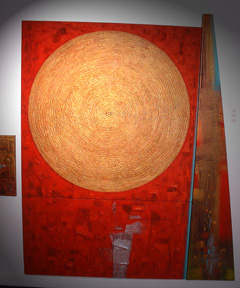
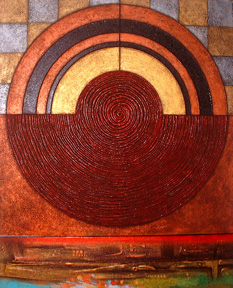
Abstract paintings pullulating with red and golden hues, black baby dolls crawling toward a television screen, and labyrinthine electronic gadgets with eerie lights sum up the “Technological Sublimation” of the award winning Filipino painter, installation and performance artist Ronaldo Ruiz.

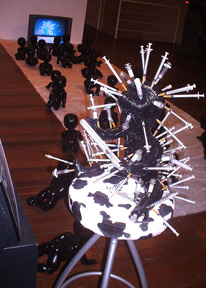
In his particular installation “Technological Sublimation”, Ruiz came up with a concept how television and computer could distort the minds of the children and teenagers with his powerful imagery of baby black dolls watching another doll on TV monitor with iconic head and body stuck with syringes. The result is hauntingly surreal and mesmeric.

The artist never ceases exploring what technology could offer in his art, be it installation or live art performance. He manipulates and exploits technological gadgets to send across his message that technology could either build or destroy. It sounds trite and banal but Ruiz, like a shaman, had masterfully delivered his ingenuity with a powerful specter of reality in our society.

In contrast to his abstract paintings, his installations and live art performances are more dynamic and visually compelling. His paintings, on the other hand, evoke the balance of forms and colors, a conscious portrayal of yīn and yang. The subdued primary colors and refined patterning textures on canvas reflect the artist’s archetypal persona.

Surprisingly, however, the artist’s installation and performance art reveal the repressed side of his personality. His installation, for instance, discloses his inner self dashed with satirical sentiment and existential angst. The unrestrained histrionic portrayal of his three-dimensional pieces serves as a liberating device of his inner struggle as an artist of incalculable vision and eloquence.

To sum, the art of Ronaldo Ruiz invites the viewers to immerse into his own world of harmony and disorder. At times, his art can be visually appealing, evoking serenity within, but most often, his art perturbs and provokes bringing the viewers to their own reality, a reality numbed with complacency and cynicism.

© Danny C. Sillada

Saturday, August 26, 2006

WAWI NAVARROZA, AS I REMEMBER HER, THEN & NOW


WAWI NAVARROZA - musician, poet, performance artist, writer and a photographer has blossomed to a full-grown artist in her pursuit for highly sensitive aesthetics.

Three years ago I met this lovely petite girl at the opening of my exhibit titled “Surreality” in White Plains, then haven of the revived Philippine Art Gallery, one of the oldest galleries in the Philippines. She was vivacious with a goddess-like face teeming with life and passion. I didn’t know then what this lovely girl’s artistic life awaits her in the future.

In 2005, our path crossed again when I invited her to read my poems at the opening of my show titled “The Collection” at The Podium, Mandaluyong City. And it was also the time when I recommended her to the PIPAF Director Yuan Mor’O Ocampo for the 4th Philippine International Performance Arts Festival that was held in September 0f 2005.

At that time, I didn’t know that Wawi is the vocalist of a rock band named “The Late Isabel” and I didn’t know either that she is already a professional photographer, who had been winning awards from photography, one of which, from the prestigious AAP competitions. Wawi is still the same girl that I met two years earlier except that her new look resembles to one of the personas portrayed by Winona Ryder in the movie.

At the opening of my show at The Podium, Wawi performed my poems with a powerful imagery of a motherland, clad in semi-Filipiniana attire with the Red Cross symbol printed on her chest and a wreath of thorns around her head. She followed the red tape trail on the floor that was created by Moro Ocampo’s live art performance earlier in the event, as a segue to her own interpretation of my poems. The thrilling response of the audience was overwhelming.

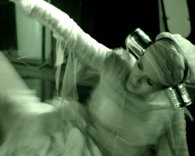
During the 4th Philippine International Performance Arts Festival that year, Wawi surprised me again with her riveting performance at the Dance Forum titled “Truth is Many and Lies in Between”. She danced like a gypsy wearing her uniquely designed attire with empty cans attached around her dress and between her head. Here, Wawi portrayed the plight of human relationship between sanity and insanity, reality and illusion, truth and lies. Her inner soul flowed like the gypsy’s ritual song resonating with her body movements - bizarre but mystical.

In her “Labyrinth” at Rajah Soliman, a durational performance of the same festival, Wawi once again enthralled the audience with her mesmerizing feat. She was wearing beige attire with hood; her face was covered with black veil while she was pulling the cart filled with household objects. One remarkable object on the cart was a lamp as though it was guiding her through a long, winding journey into a dimensional world.

With her natural sense of theatrical characterization and sensitive use of framing devices in her live art performance, Wawi emerged like a powerful “babailan” or shaman, provoking and engaging the ‘sore spots’ of her audience. Her haunting portrayal of symolic elements is reflective of her passion as a photographer, capturing not only the visual images of her performance but stories of her subjects in detail.

Today, I see Wawi as a delicate legendary flower in my land in Davao called “Itum na Buwac” or the “black orchid”; her smell spread out throughout the mountains and rivers, reaching out and healing the lonely souls through her aesthetic creation.

© Danny C. Sillada

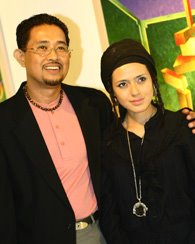
photos (from top to bottom): (1) wawi's poetry performance at my 7th one-man show at the podium, 2005; (2) Wawi & me at the opening of my 8th one-man show at art center, sm megamall, 2006; (3) wawi at dance forum, philippine international performance art festival, 2005; (4) wawi at rajah soliman, philippine international performance art festival, 2005; (5) wawi reading my poems at the opening of my 8th one-man show at art center, sm megamall, 2006.

Wednesday, November 16, 2005

Director Elwood Perez, Maui Taylor & Me in "Private Parts"

Maui Taylor & Me
Filmmaker Elwood Perez, the most rumored movie actress Maui Taylor and Me in “Private Parts?

Well, not really but it was my controversial painting “Menstrual Period in Political History”, which will be used as part of the play at the Music Museum in Greenhills on November 30 – December 1, 2005.

I thought, after a brief hiatus from the controversy in Philippine art scene, one of the contentious pieces that I exhibited early this year will be laid to rest forever in anonymity. Until a week ago, my good friend, a legendary and multi-awarded movie director, Elwood Perez, called me on the phone that he is going to use the artwork as icon of private parts, literally and figuratively, in his theatrical show titled “Private Parts”.


Director Elwood Perez, Myself & Paula Brillson.
At first I was hesitant to say yes, but later I realized that it was him and another friend Paula Brillson, a lawyer and media consultant from New York, who fought and stood by me at the height of my controversial one-man show at The Podium last July 2005. For one thing, it was too offensive, according to the mall manager, to the sensitivity of the Filipinos because of the outright portrayal of vaginal form. Second, it was a provocative artwork criticizing the political leadership of a female President of the country.

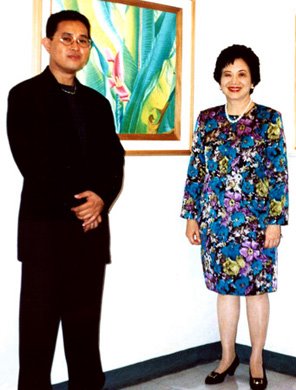
Me & the former Pres. Corazon Aquino in 1996.
It was also during the time of my exhibition that the former female president, Madam Corazon C. Aquino, went out from the comfort of her shell and led a massive rally at the Ayala Avenue in Makati protesting the present Madam President, Gloria Macapagal-Arroyo, to resign from her post because of allegedly electoral fraud that won her presidency with its infamous nickname “Hello Garci”.

Because of the irrational uproar on the vaginal form and the political content of my artwork, the rally of Madam Cory and the “Hello Garci” hullabaloo, my two prospective collectors, a Belgian and a Filipino-Chinese who were vying to own the “Menstrual Period in Political History”, withdrew from the reservation list because they don’t want their names to be dragged into the controversy.

Menstrual Period in Political History 1 The Cocoon of Life, 2001 Poetry of Nails and Blood
"The menstrual Period in Political History", mixed media on metamorphic rock (left), "The Cocoon of Life",oil on paper (center), and the "Poetry of Nails & Blood", acrylic and nails on metamorphic rock and board.

Ironically, these two female presidents (past and present) had, in one way or another, been connected to my art. Madam Cory Aquino had been a guest of honor in a group show that I participated in 1996 at the Eugenio Lopez Museum while Madam Gloria Macapagal-Arroyo owned my painting titled “The Cocoon of Life”, a gift to her by my aunt, Congresswoman Corazon Nuñez-Malanyaon, during the president’s visit in my town two years ago.

Fashion Model Avi Siwa
Meanwhile, visiting the rehearsal of “Private Parts” at the Viva Productions studio was exciting because I met another legendary and veteran movie director Behn Cervantes and, of course, Maui Taylor, and other casts of the play.

Talking of Maui Taylor, she is a very lovely cuddly petite young woman whose angelic face could be mistaken as an innocent girl next door. She is not a prima donna type of actress but down to earth, soft spoken, intelligent with mesmerizing presence.

Actor-producer Allen Dizon
In the middle of our conversation about art and philosophy, which eventually led her plan to purchase one of my works the “Poetry of Nails and Blood” for her condominium unit, Maui asked me to join her lunch at 5 p.m. (?) while other casts were still rehearsing. She was so hungry that she finished two meal-packs of scrumptious spaghetti served by Dennis Evangelista, the manager of movie actor Allen Dizon.

The “Private Parts”, written by another friend screenplay writer Jigz Recto, is a satirical take on the politics in show business and the dying "sexy movie" industry in Philippine cinema. The play is produced by actor Allen Dizon and his manager Dennis Evangelista; music by Jobin Ballesteros and choreographed by Bong Embile.

Fashion model/movie actress Wilma Doesn't.

The casts are director Behn Cervantes, the controversial movie actress who had been linked to the presidential son, Maui Taylor, actor and producer of the show Allen Dizon, Wilma Doesn't, Myles Hernandez, Ynez Veneracion, Avi Siwa, Vangie Labalan and Margie Sofia Rei under the direction of Director Elwood Perez and assistant dierctor Armando Reyes.

The “Private Parts” will be shown on November 30 – December 1, 2005 at the Music Museum in Greenhills, Quezon City.

© Danny C. Sillada