Showing posts with label performance art. Show all posts

Sunday, August 01, 2010

Poetry & Live Art Performances at Cesare Syjuco’s ‘Ancestry of Stone’


“I don't think artists can avoid being political. Artists are the proverbial canaries in the coalmine. When we stop singing, it's a sure sign of repressive times ahead.”
- Theresa Bayer

It has already been a tradition for a multi-disciplinary artist to invite poets, performance artists, and musicians to perform at the opening of his or her show. The convergence of different artistic mediums at the opening of Cesare Syjuco’s exhibit, for instance, produces interactive dialogues between the artists and the audience. And for the audience, it has always been a treat to witness such unique gathering of artists from different disciplines to reveal their aesthetic discourses through poetry, music, and live art performances.

Among those who performed at Cesare’s “Ancestry of Stone” last July 24, 2010 at Galleria Duemila in Pasay City were Gimeno H. Abad, Alfred “Krip” Yuson, Rayvi Sunico, Vim Nadera, and Maxine Syjuco for poetry; Cesare Syjuco, Mitch Garcia, Ian Madrigal, and this writer for live art performance; Lirio Salvador, J.P. Hernandez, and the members of Elemento for music.

Gimeno Abad always performs his poems from memory, thus speaking his poetry from his soul. The lightness of his persona and the sound of his placid voice emanate a buoyant atmosphere, cradling his audience with the rhythm of his verses. Alfred Yuson, on the other hand, seems blasé yet bubbly the way he engages his listeners with his spoken words. He always delivers his poems with wit and humor, titillating the mind and heart of the audience as though he was seducing a woman. Rayvi Sunico, a bilingual poet, speaks his poetry with such passion, drawing his audience closer to the texture of his linguistic expression.

Clad in tuxedo impersonating an opera singer, if not Pavarotti, Vim Nadera rouses the audience into laughter when he sang the name of Cesare Syjuco to the tune of “Besame Mucho”. Wearing a white mask and hand gloves, this writer also performed a poignant piece titled “Suicidal Tears”, an existential cry of anguish and despair, as expressed through bodily movements and bloody tears that came out from the mask’s eyeholes.

Lirio Salvador, the founder of ethno-industrial band called Elemento, redefines avant-garde music with eclectic sound that comes from assembled electronic and metal scraps. His orchestral music, with J.P Hernandez playing the percussion, creates an ambient backdrop for other artists to perform their pieces, like the sensual and mesmeric Maxine Syjuco with her short poem about the rain. Then, later, it was segued by Mitch Garcia, showing off her written statements on sheets of paper before the audience. One of her conspicuous avowals says: “Atheism is a non-profit organization.”

Cesare Syjuco’s performance is indubitably satiric and whimsical, luring his audience to listen attentively to the playful sound of his plastic gun with his emotive soliloquy: “She loves me, she loves me not…”(The man himself seemed to be overwhelmed and gratified over the success of his show). Noticeably, among the audiences were from showbiz, like Ronnie Lazaro and Joel Torre, and visual artists, like Tony Twigg with his wife, Gus Albor, Eghai Roxas, Red Mansueto, Roberto M. A. Robles, Raffy Ignacio, Boy Achacruz, and UP Professor and art critic Reuben Ramas Cañete, to name a few.

Hosted by gorgeous Trix Syjuco, co-host of Illuminati opposite Alfred Yuson at GNN Destiny Network (Channel 21), the superbly curated “Ancestry of Stone” and the entire performances were aesthetically orgasmic, culminating with exotic food, beer, and wine.

After the guests left one by one before midnight, this writer with Jean Marie Syjuco (painter and performance artist), Silvana Diaz (gallery owner), Lanie Aquino (cousin of PNoy), Gus Vivar (publisher), Mary Ann Sillada (Director of Neatnix Philippines), and Ilac Diaz (Pinoy social entrepreneur, activist, and model) relished once again the oeuvre of Cesare with a warm conversation on arts and culture, social issues, politics, and, of course, religion.

It was, after all, a night of aesthetic revelation that reopens our eyes to many facets of political and social realities, and a beginning to renew our hope and trust to our new political leader. And as one of Cesare Syjuco’s artworks says, “God Speaks to Cesare,” we (visual artists, writers, poets, and indie filmmakers and musicians) are hoping the same thing that God will already break His long silence and, this time, HE WILL SPEAK TO NOYNOY to bring peace, harmony, and prosperity in our country!

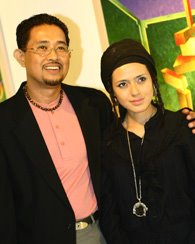
Lanie Aquino, Gus Vivar, Ann Sillada, Danny Sillada (me), Jean Marie Syjuco and Silvana Diaz

© Danny Castillones Sillada

Thursday, October 02, 2008

Revelation of Secrets & the Aesthetics of ‘Syjuco Tres Marias’


"The things we keep secret are always bigger and more frightening in the darkness than they are in the light of day."
– Elspeth Allcott
Published in 
Manila Bulletin, Pages F1-2, Lifestyle Section, September 8, 2008

In the corpus of aesthetic language, the disclosure of secret is the poetic revelation of truth through visual, literary and performing arts. As a poetic revelation, aesthetics uses visual imageries to reveal what is hidden based on the artist’s personal encounter of reality within a particular society.

This revelatory process is autobiographical by nature because art or any work of art, for that matter, is always personal – either representative of the artist’s reality or the reality of his or her environment. However, before the reality can be processed and translated into art, it has to percolate from the artist’s psyche and experience.

Inherently, the creator is personally involved in the process of art making so that, when a particular work of art is finally revealed, it becomes the “incarnate” of Truth from the artist’s perspective to be understood and deciphered by a historical society where art is created and addressed to.

MAXINE SYJUCO: “A SECRET LIFE”
In her first collection of poems titled “A Secret Life”, Maxine R. Syjuco is like a spider that lures her reader to tiptoe into the web of her secret world. She passionately weaves the vignette of her thoughts and feelings in-between verses, flutters and spins her delicate “voice” with grace and elegance, until the reader is gradually trapped within the complex web of her poetic creations. Dense and abstruse in form and substance, Maxine’s collection of poems possesses the characteristics of John Berryman’s lyricism, Sylvia Plath’s bold and elliptical lines, Anne Sexton’s sardonic voice, and Robert Lowell’s complex and autobiographical style of writing.

The 1950s and 1960s are described as the beginning of popular culture, the gradual collapse of cultural values and beliefs, the pluralism of social and political ideologies, and the advent of a technological and consumerist society. It was also the time where existentialism was gaining its momentum from such prominent literary figures like Jean Paul Sartre, Simone de Beauvoir, and Albert Camus.

The same era that “confessional poetry” emerged from the influential American poets such as Robert Lowell, identified as the father of confessional poetry, Sylvia Plath and Anne Sexton (both students of Lowell), and John Berryman that would later change the history of American poetry.

In the local literary scene of post po-mo “confessional poetry”, Maxine’s voice emerges as the dialectical representation of her generation. Her poetry addresses some salient issues, which are eminent in the post po-mo society, i.e., the dislocation of hierarchy of values and the susceptibility of human psyche amid the “created realities” offered by popular culture.

The poems “Dear Mr. Prick”, “How to Murder a Naked Woman,” and “Red Light District: Lost Rules of Usage” are looming pictures that mimicked the sensationalized staging of realities in mass media.

Other poems like “How to Murder a Mocking Bird,” “Caution: Falling Debris,” “That Men Are Creatures,” and “Mrs. Stitcher” are derisive protests on traditional values and beliefs, whose beneficiary-victims are, most often, the children and the submissive wives of a conservative Filipino society.

Her poems, per se, are not self-revelatory confession of personal anguish and torment, which are inherent of Lowell, Sexton, and Plath’s poetry, but more on Berryman’s subtle and lyrical characterization of different personas, addressing the Freudian’s “Id,” “Ego,” and “Superego”.

Using the “I” in most of her poems, Maxine has always emerged as the heroine of her oedipal narrative, a subtle dissent from the symbol of authority and traditional system of thoughts. Similarly, the poems “To Sartre,” “I Am in Love with Galileo,” “Chewing Chopin,” “Dear Seurat,” “Jackson Pollock and I,” and “Who Shot Bukowski?” are transferential reverberations of her academic studies, a satiric gripe against the prominent figures in Humanities.

Another salient element in her poetry is the use of familial imagery, exploring Jungian’s theory on personal and collective unconscious. In “Mrs. Stitcher”, for instance, there is the displacement of the imagery of “context”, blurring the lines between symbol and the actual derivation of reality.

In another poem “Caution: Falling Debris”, it opens: “My father was a drunken carpenter/ who liked to build fires. / He built three great fires in his lifetime, / all in all, at least, that’s what I remember.” Then, in the fourth paragraph, the father was trapped, figuratively, by his own fire “until he became a silhouette” including his daughter and wife “where recycling was not cheap”.

Gothic, witty, irreverent and, at times, laden with dark humor, Maxine has woven a new kind of poetry reflective of her generation. Her eccentric use of words and imageries creates a poignantly strange linguistic expression, which is unique to her voice: Freudian, surreal and existential.

“A Secret Life” is slated for launch in September at Mag:net Bonifacio High Street. A second launch will be held in October in Indonesia with her father Cesare A.X. Syjuco and Alfred A. Yuson, among the Filipino representative poets at Ubud Writer’s Festival in Bali.

MICHELLINE SYJUCO: “THE PRIMAL FORMS”
Another aesthetic revelation that was unveiled by one of the “Syjuco Tres Marias” last August 8, 2008 at Mag:net Café, Bonifacio High Street, is Michelline Syjuco’s collection of sculpted jewelry on metal titled “Armadillon”.

It features the artist’s handmade jewelry designs, which are made of unique and intricately sculpted and soldered metals, embedded with spikes, bullets, clenched pearls, gemstones and fragments of rocks from outer space.

Guest of honor National Artist Napoleon Abueva and other notable guests the poet and columnist Alfred A. Yuson, art critic-artist Cid Reyes, and restaurant mogul Raymond Reyes, among others, graced the opening of the event. Landscape and interior designer Al Sibal curated the show.

The opening of Michelline’s exhibit was a historic evening – “The ocho-ocho weekend that was” – as described by Alfred Yuson in his column “Kripotkin”, because of so many events that were unveiled that Friday (08-08-08) in the local art scene, needless to mention the opening of Beijing Olympics in China.

Packed with sardine-like crowd inside the Mag:net Café, the event was highlighted with the fashion show of “Armadillon” collection. Fashion models include Trix and Maxine Syjuco, Arianne Tonda, Cami & Chinky Hiquiana, Iza Elises, Natasha Rodriquez and this writer, the only thorn among the roses.

It was followed with live performances of poetry, music and performance art by the usual members of the Electric Underground Collective: Cesare A.X. Syjuco & Jean Marie Syjuco, The Syjuco Sisters, Eghai Roxas, Yanna Acosta & Project Ganymede, Alfred Yuson, Bailan & Ukay-Ukay bands, Bob Balingit & The Wuds, Alan Rivera, Danny Sillada & Mangayaw band, Mannet Villariba, Lirio Salvador & Elemento, Mitch Garcia, Art Casanova, Ian Madrigal, The Slave Drum, Parking in Mogadishu, to name a few.

The “Armadillon” collection is the debut exhibit of Michelline Syjuco, the eldest sisters of the “Syjuco Tres Marias”, daughters of avant-garde artists Cesare A.X. Syjuco and Jean Marie Syjuco. The exhibit is extended up to the month of September at Mag:net Café, Bonifacio High Street.

TRIX SYJUCO: “THE BLACK BRIDE”
As an offshoot of visual art, performance art subverts the form and structure of conventional art making by using material devices and bodily movements in presenting the imagery of reality during the performance.

Contrary to performing arts like dance, theater and musical, live art performance is a dynamic and unrehearsed presentation of symbolic images through live actions in front of the audience.

In her recent performance at the opening of her sister’s (Michelline Syjuco) jewelry collection at Mag:net Café, Trix Syjuco stunned the audience with her riveting feat in “Black Bride”. Clad with black wedding dress while her collaborator, acting as a priest-bridegroom (this writer), is wearing a white cassock and satin scarf with eye-shades covering his face.

The contrasting images are hauntingly surreal; the priest, instead of sanctifying the sacrament of matrimony, was going to marry the bride. In the same vein, the bride’s black wedding dress, a traditional symbolic color for a widowed wife in mourning, amplifies the gothic and bizarre imagery of the performance.

The tension heightens when the bridegroom (the priest) and the bride reenact a bodily sensual encounter in a dance-like movement. Then, the latter, as if awakened from demonic spell, chastises the bride by wrapping her body and face with plastic sheet. The bride, to complete the ritual, sprinkles her head with black and white powder and pours out the holy water on her body.

Passionate, primal and, at times, perturbing, Trix Syjuco’s performances break the wall of her mild-mannered archetypal “self” without subverting the form and content of her live art presentation. Her performances like “I Fell in Love with a Killer”, “Plastik” and “Black Bride”, to name a few, inherently follow a trail of existential angst, disillusionment, and embittered human relationships.

Her subtle use of imageries and devices is intelligently delivered in a dialectic manner, purging and liberating the harrowing quest of her inner persona as a woman and as an artist and, at the same time, creating a succulent seedbed to grow and nurture her aesthetics.

 © Danny Castillones Sillada

Saturday, August 26, 2006

WAWI NAVARROZA, AS I REMEMBER HER, THEN & NOW


WAWI NAVARROZA - musician, poet, performance artist, writer and a photographer has blossomed to a full-grown artist in her pursuit for highly sensitive aesthetics.

Three years ago I met this lovely petite girl at the opening of my exhibit titled “Surreality” in White Plains, then haven of the revived Philippine Art Gallery, one of the oldest galleries in the Philippines. She was vivacious with a goddess-like face teeming with life and passion. I didn’t know then what this lovely girl’s artistic life awaits her in the future.

In 2005, our path crossed again when I invited her to read my poems at the opening of my show titled “The Collection” at The Podium, Mandaluyong City. And it was also the time when I recommended her to the PIPAF Director Yuan Mor’O Ocampo for the 4th Philippine International Performance Arts Festival that was held in September 0f 2005.

At that time, I didn’t know that Wawi is the vocalist of a rock band named “The Late Isabel” and I didn’t know either that she is already a professional photographer, who had been winning awards from photography, one of which, from the prestigious AAP competitions. Wawi is still the same girl that I met two years earlier except that her new look resembles to one of the personas portrayed by Winona Ryder in the movie.

At the opening of my show at The Podium, Wawi performed my poems with a powerful imagery of a motherland, clad in semi-Filipiniana attire with the Red Cross symbol printed on her chest and a wreath of thorns around her head. She followed the red tape trail on the floor that was created by Moro Ocampo’s live art performance earlier in the event, as a segue to her own interpretation of my poems. The thrilling response of the audience was overwhelming.

During the 4th Philippine International Performance Arts Festival that year, Wawi surprised me again with her riveting performance at the Dance Forum titled “Truth is Many and Lies in Between”. She danced like a gypsy wearing her uniquely designed attire with empty cans attached around her dress and between her head. Here, Wawi portrayed the plight of human relationship between sanity and insanity, reality and illusion, truth and lies. Her inner soul flowed like the gypsy’s ritual song resonating with her body movements - bizarre but mystical.

In her “Labyrinth” at Rajah Soliman, a durational performance of the same festival, Wawi once again enthralled the audience with her mesmerizing feat. She was wearing beige attire with hood; her face was covered with black veil while she was pulling the cart filled with household objects. One remarkable object on the cart was a lamp as though it was guiding her through a long, winding journey into a dimensional world.

With her natural sense of theatrical characterization and sensitive use of framing devices in her live art performance, Wawi emerged like a powerful “babailan” or shaman, provoking and engaging the ‘sore spots’ of her audience. Her haunting portrayal of symolic elements is reflective of her passion as a photographer, capturing not only the visual images of her performance but stories of her subjects in detail.

Today, I see Wawi as a delicate legendary flower in my land in Davao called “Itum na Buwac” or the “black orchid”; her smell spread out throughout the mountains and rivers, reaching out and healing the lonely souls through her aesthetic creation.

© Danny C. Sillada

photos (from top to bottom): (1) wawi's poetry performance at my 7th one-man show at the podium, 2005; (2) Wawi & me at the opening of my 8th one-man show at art center, sm megamall, 2006; (3) wawi at dance forum, philippine international performance art festival, 2005; (4) wawi at rajah soliman, philippine international performance art festival, 2005; (5) wawi reading my poems at the opening of my 8th one-man show at art center, sm megamall, 2006.

Tuesday, October 18, 2005

A NIGHT OF LIVE ART AT PENGUIN CAFÉ WITH CHUMPON APISUK by Danny C. Sillada


Chumpon Apisuk, photo by Danny Sillada © 2005.

The night had just started at 11 p.m. on the busy streets along the Remedios Circle in Malate. Metro hoppers – artists, poets, writers, corporate executives and young lovely women – flocked to one of the busiest bars on a Friday night in Manila.

One of those frequently visited bars by the artists is the Penguin Café – the haven of visual and performance artists, theater and dance artists, movie actors, poets and art enthusiasts. Chumpon Apisuk, founder of Asiatopia, an Asian Performance Art Festival in Bangkok, came and performed at the café with other Filipino performance artists headed by the founder and artistic director of PIPAF Yuan Mor’O Ocampo.

There were eight performance pieces that rapt the audience on the 14th of October 2005 – a one-night happening in honor of the legendary performance artist from Thailand – Chumpon Apisuk.

Performance Artists and their Live Art performances:

1. Ronaldo Ruiz “Revenge”
2. Yuan Mor’O Ocampo “Diaspora”
3. Danny C. Sillada “Sewing the Hole of Water”
4. Jethro Jocson “Drifting and Falling”
5. Mitch Garcia “Desserts/Stressed”
6. Lorina Javier “Submission to the Void”
7. Jeho Bitancor “Mirror Image”
8. Chumpon Apisuk “Five Actions of Body Performance”

RONALDO RUIZ's "Revenge"


Ronaldo Ruiz

Ronaldo Ruiz’s opening performance titled “Revenge” reexamines his trademark of sound using small electronic gadgets such as microphone, speaker, camera, electronic alarm and recorded sounds of frog and cicadas. As he moves his hands from one gadget to another, he produces different sounds creating an ethereal and discordant noise, resonating with the recorded nocturnal sounds of the frog and cicadas at the background.

One riveting gesture is the swinging of a small microphone near the speaker, creating a rhythmic sound in a circular motion, as if time and space converge in a g-force to create the poetry of sound and movement. On the other hand, there seem to be an internal incubation of crossness that was released inside the artist’s chest in the process of swinging the microphone, more liberating than the title itself “Revenge”.

Ruiz’s penchant for electronic gadget explores the sound like a conductor of an orchestra with his own hands. But unlike an ensemble of musicians, Ruiz has the control of manipulating the sound to his own liking in a random and spontaneous manner. There is a certain degree of playfulness in the process of his performance and his imagery evokes wonder and curiosity of a child.

Ronald 2
Photo by Danny C. Sillada © 2005. UGNAYAN Journal

DANNY SILLADA's Sewing on the Hole of Water


Danny Sillada

The third performance was done by this writer (Danny Sillada) titled “Sewing the Hole of Water”. With a bowl of water, I began to lay the white thread with silver strand through a large needle’s eye, and after pulling the thread in equal length, I knotted both ends.

Then, I started to sew the imaginary holes on the water. With my eyes focused on the bowl, I dipped my right hand fingers with needle and thread into the water and pulled it up gently into the air as if I was sewing a sack of rice. A minute later, a liquid leached into the air turning my fingers and the water into red: an image of blood appeared on the bowl of water.

‘Is there really a hole on the water?’ I asked the audience with rhetorical question. I explained that while there could be a space in-between the molecular elements that composed the water (hydrogen and oxygen), ‘It is impossible to see ahole on the water through the human eye…’ But that was beside the point. What I was trying to sew, if not to say, on the water was the rotten hole of our economic and political conditions, the rotten hole of our constitution and the rotten hole of our political leaders.

The transformation of water into an image of blood symbolizes the anguish and the predicament of Filipinos who could hardly see a light of hope from in our tormented society.

Danny 2
Photo by Ronaldo Ruiz (c) 2005.