“Modern art touches a sore spot, or several sore spots, in the ordinary citizen of which he is totally unaware. The more irritated he becomes at modern art the more he betrays the fact that he himself, and his civilization, are implicated in what the artist shows him.”
-William Barrett, Irrational ManPublished at Manila Bulletin, Lifestyle Section (Art & Culture)
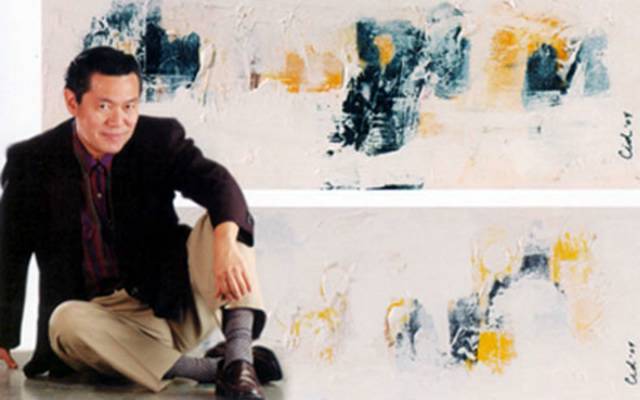
In his insatiable quest for aesthetic meaning, Lindsey “Lindslee” James Lee questions whether abstract art is the end in itself defaced and bereft of figurative elements on a flattened surface of canvas. Or is it an indefinite medium open to a more concrete signification in relation to the image man amid his changing society.
In his provocative paintings and installations with thematic title “Figuring Abstraction”, the artist challenges the normative concept of abstract art as a medium. In the same way, as po-mo (post-modern) art questions whether the image of man is confined within the traditional and conventional belief, or is it shifting toward a more concrete definition in the post-modern society.
In the “Wake-up Call” installation, for example, Lindslee nestled a taxidermal rooster on top of a backlit box. At the right side of the box is an inscribed text “Idealism” and on the left “Paranoia”. The rooster, in an elegant posture, is clothed with knitted pink apron in a fashionable manner as though the chicken is geared up to ramp before the audience.
Tinged with satire and sarcasm, the sculptural installation signifies the existential reality of man and his society. Lindslee dissects the darker side of human psyche torn between the pendulous tensions of idealism and paranoia. The haunting imagery symbolizes the two opposing sides of man’s perception of reality. He can either be fearful and suspicious of reality or he can be desperate to believe on something sublime, which is beyond the rational comprehension of man’s consciousness.
As indicative in his incisive use of symbols, the artist completely deconstructs the finitude of abstraction by substituting it with a more sensual and perceptible elements. The use of taxidermy, for instance, and the aleatory portrayal of figures, amplifies the inevitable reality in the context of his own image of man within and beyond the borders of his creation.
Figuring Abstraction: The Equivocal Meaning
 Figuring Abstraction, as an ambiguous theme, is the artist’s discursive proposition from savoir-faire (conventional or commonly accepted norms) to savoir-vivre (the ability to live and explore beyond the conventions or the given sets of rules and values).
The savoir-faire, as employed by this writer in the context of modern aesthetics, is the inherent principle of art as an end itself with fixed essence and nature – i.e., material composition, form, color and texture – its capability to become in-itself and for-itself. The savoir-vivre, on the other hand, is the symbolic principle transcending beyond its material composition – the source of revelatory meaning in contrast to what is conventionally accepted as a norm.
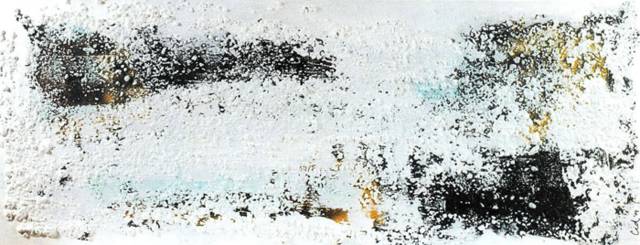
For instance, in one of his abstract paintings titled “Defining Gravity”, the artist painted a varying tone of black, white, and grey colors. At the upper left of the canvas, is an undefined mass of crimson lake adjacent to the realistic figure of man (self-portrait) standing on his side. The textures and colors of the canvas are arbitrarily arranged, which is, evidently: the characteristics of abstraction.
What makes the artwork arresting amid its mass of undefined forms and colors is the portrayal of realistic figure within the canvas. Otherwise, without the figurative aspect of the composition, the canvas is bleak and dreary. Obviously, the artist intentionally infused the figurative element to create a pictorial tension. Hence, the title “Defining Gravity” literally creates a gravitational impact within the composition and from the perspective of the viewers.
The artist, subsequently, redefines and introduces new dimensions in abstraction. First, he explores the aleatory symbol of selected elements, i.e., the realistic depiction of man, chicken, ladder or bicycle, etc., as a shifting device to put gravitational weight on the surface of his canvas.
Second, the artist does not only explore what is abstraction in literal sense. He uses his auxiliary skill as a taxidermist to heighten the symbolic meaning of reality within the forms and structures of his creation.
The Taxidermal Elements
 As an abstract and taxidermy artist, Lindslee skilfully concocted a more challenging formula in his art by integrating the two aesthetic entities into his works.
The unique use of taxidermal elements in Lindslee’s art is arbitrarily born out of the desire to explore and elevate his aesthetics into a more concrete expression of reality, a reality from which the artist wishes to reveal be it beautiful or ugly.
In his work titled “Ugly Painting”, an installation of taxidermal duck sitting on a bench painted with the figure of Jesus Christ (Sacred Heart); the picture is painted at one side of the bench. Below the bench is a huge white egg, which is five times larger than the life-size duck.
The symbolism of the duck, giant egg and a religious icon elicits a haunting reality. The poignant imagery signifies two realities. First, it symbolizes the complacency of man’s religious faith, still being hatched, as shown on the figurative symbol of giant egg. Second, the work itself becomes a symbolic icon of complacency in creating a more sublime aesthetics. It is a common experience among artists, who have already attained the pinnacle of their creativity; it is as though nothing is worth exploring anymore in art making.
The taxidermal elements did not only signify the reality that Lindslee wanted to portray in his art. But it also magnifies that same reality to a higher level of man’s consciousness and his struggle to create and to become. As a supplementary device to his art making, the artist has achieved his artistic freedom with magnificent force, creating a powerful medium in his quest for a highly sensitive aesthetics.
The Aesthetic Symbol as a Revelation of Truth
 The use of symbolism in Lindslee’s art is generally coherent and rational but, at times, it can be capricious and satirical. In his painting titled “Vindicated”, the artist reveals a bleak symbolism – epitomizing his existential perception of life.
Typical of his abstract works, the canvas is pullulating with undefined mass of forms and colors. At the upper left portion of the canvas, is a realistic figure of a tilted diamond ring. An inscribed text is passing through the ring cascading down to the bottom of the canvas that says: "Things are made to be broken".
Obviously, the symbolic meaning is about a broken relationship. At a second look, however, one can feel that looming shadow of intangible sadness enshrouding his canvas. There is that feeling of resign and surrender that all things in this world, sooner or later, will pass away, and what remains is the awful reality of death and mortality.
“Everything is meaningless”, says the artist, “because someday, like man’s life, my art will vanish and disappear in oblivion”.
Despite the drab portrayal of reality, the artist’s symbolism persuasively touches the delicate part of human soul. His revelation of truth is a symbol of the here and now, penetrating the human psyche with urgency, anchoring man’s existence to his bleak but concrete reality.
The Unity of Art and the Vision of Reality
 Is the interpretation of art limited to a particular medium or genre? Or, is it open to a more daring concept that reflects the shifting image of man in the post modern society?
As an artist of magnificent vision, Lindslee questions the parameters of abstraction, goes beyond its conventional form, and redefines his own modal structure of art making. The unity of aesthetic concept and his vision of reality culminate not from mere painting the surface of his canvas, but by integrating and fusing one or more mediums into his art.
Generally, abstract art is flat and abstruse, plane and simple. However, the artist goes beyond from its flattened surface to a more concrete signification of reality. He proposes, vis-à-vis, a dialectical concept of what it could become as a symbolic entity in contrast to the pre-conceived reality of art as a genre in-itself and for-itself.
In the end, the shifting of the artist’s vision, his dialectical concept and his departure from the normative practice of art making has become a liberating device to embrace the limitless possibilities of art rather than being confined within the conventional principles of aesthetics.
To sum, symbolism in po-mo art, be it visual, literary, film or music is boundless and metaphysical. It transcends the bleakness of the world and conquers the absurd by magnifying and revealing concrete realities so that the post-modern man may live with profound meaning and understanding of life in the midst of his changing society.
Creative freedom, like the infinite space of the universe, is boundless and eternal.
© Danny Castillones Sillada
--------------
*ABOVE PHOTO: Photo of artworks coutesy of the artist; 2008 works.