Showing posts with label abstract art. Show all posts

Sunday, December 19, 2010

The Existential Appeal of 'Soloism' in Aesthetics (The Eccentric Art of Francisco Pellicer Viri)


Francisco Pellicer Viri and his works, photo by Danny C. Sillada

Published in Manila Bulletin (Arts & Living), December 6, 2010

“Language has created the word ‘loneliness’ to express the pain of being alone. And it has also created the word ‘solitude’ to express the glory of being alone.”
– Paul Tillich

IN THE LAST three lines of his poem, The Solitary Reaper, William Wordsworth extols the melancholic song of a woman harvesting in the fields of Scotland. The speaker in the poem goes through a transferential loneliness that the solitary reaper sang in her heart when he says: “And, as I mounted up the hill, / The music in my heart I bore, / Long after it was heard no more.”

An artist, in general, is solitary, not because he wants to escape or avoid the bustling routine of familial or societal life, but to find his own solitude where he can be at home with himself and his art. Paradoxically, it is only in solitude that an artist can see the world with unparalleled vision, exploring his boundless freedom to create.

One such artist who immerses himself with recurrent themes of loneliness, solitude, and estrangement is Francisco Pellicer Viri. He epitomizes the organic and intangible state of solitude on his canvas and paper. Unbroken line traverses amid the overlapping mass of planes and colors, self-contained and undefined figure emerging, aloof and distant yet outreaching, like an abandoned child on the street, hungering for human affection.

But Viri’s works are beyond empirical representations, they are transcendental portrayals of an existential journey born out of a throbbing solitary existence.

It is for this reason that his art can be categorized within the vein of ‘soloism.’ In the language of aesthetics, Soloist Art or solo-art, as coined by this writer, is an artistic principle that perceives life as a solitary struggle, a constant creative struggle to make life sensible amid the irrational realities of human existence.

As an artistic idiom, ‘soloism’ can be expressed in other modes of creative activities, like poetry, music, or performance art. Most often, it manifests the drab reflections of man’s harsh conditions in the society.

Some elements of “soloism” can be found in the works of painters Francis Bacon, Egon Schiele, and Edward Munch; confessional poets John Berryman, Sylvia Plath, and Robert Lowell; existentialist philosophers Friedrich Nietzsche, Jean Paul Sartre, and Albert Camus, among others. Soloist art is akin to existentialism except that, as an aesthetic principle, it actualizes human freedom and purpose in life through creative activity.

“It is a linear philosophy which is trying to express an underlying need for a sense of order due to the psychotic disturbances found in everyday life,” Viri describes his art with succinct candor, bereft of sentimentalism. “My images are essentially a personal figurative abstraction which, in the recent years, evolves into one ‘unbroken line’ of figure.”

He is one of the few artists who can articulate his mind with cogent opinion and perspicacious acumen. However, amid all his forms and colors is a lonely creator trying to make sense from incongruous circumstances that constantly hound his lonely existence.

A bachelor in his 50s, no family, parents, or siblings to anchor his dreams, thoughts, and feelings, he lives an eccentric, solitary life, which is ubiquitous in his works. In fact, there is a very thin line that borders between his life and his aesthetics. His life and his art seem to exist in symbiotic manner, giving a teleological reason for each other’s existence.

His iconoclastic frame of thinking is reflective of his educational background and assimilated cultures during his travels and stints abroad. Similarly, although he does not identify his creative style and technique to any artistic movements, it is obvious that his works are avant-garde assertions against the conventional.

He studied in Rhode Island School of Design, known as the number one fine arts college in the United States, and finished his BFA degree in Illustration in 1979. From then on, Viri would travel to several countries to exhibit his works, but he would always come back to his motherland in the Philippines. From 1990s to the present, he has already launched several one-man shows and participated occasional group shows in Metro Manila galleries.

The turning point of his artistic career came when his brother died, leaving him alone and devastated. “My brother died on September 8, 2007,” Viri recounts with a trace of gnawing sadness in his eyes. “I watched him having five successive heart attacks in the span of three days until he died in the hospital.”

The loss of his brother is parallel to the loss of Theo to his elder sibling Vincent van Gogh, except that Viri lost a supportive brother, like Theo, who stood by his side throughout his artistic career. Viri could have uttered the same poignant words written by Theo to his mother after the tragic death of Vincent: “It is a grief that will weigh on me for a long time and will certainly not leave my thoughts as long as I live…” (August 1, 1890, Paris; R.G. Harrison)

What is life without tragedy, what is art without solitude or madness!

One can remember the tormenting loneliness of an American poet Sylvia Plath or the remaining years of a famous German philosopher Friedrich Nietzsche. The latter suffered from chronic melancholia before he died in Weimar on August 25, 1900, while Plath succumbed to self-destruction during one of the coldest winters in Europe on February 10, 1963.

On a positive note, Emily Dickinson, out of her lonely, secluded life, had written the most important collections of poetry in the history of world literature. Romanian philosopher E.M. Cioran wrote the most compelling philosophical treatises and reflections in Paris, while living in poverty away from his homeland. The German composer and pianist Ludwig van Beethoven created some of his greatest masterpieces; he was deaf and he died a pauper without even hearing the heavenly sound of his music.

Despair, solitude, tragedy, or poverty can break the artist, but it can also redeem and propel his aesthetic freedom to create a magnificent opus.

Viri’s solitary life was heightened after his brother’s death, but he never gave up. His art is not only a vehicle to find meaning in the midst of chronic solitude and tragic past, e.g., the death of his beloved brother and parents respectively; it becomes his life and his life becomes his art, trying to make sense from a seemingly absurd existence.

Great works of art are not created from the allure of comfy environment, but from the creator’s debilitating solitude, in a manner of speaking, traversing through a perilous journey between darkness and light in order to give birth to his creation. It is during this harrowing process that an artist can be so fragile, like a delicate crystal; yet, he can also be formidable, transforming himself and his art into a metaphysical encounter with Truth, Good, and Beauty.

Art, to reecho Viri’s unassuming statement, “is to express an underlying need for a sense of order due to the psychotic disturbances found in everyday life.”

© Danny Castillones Sillada

Wednesday, December 02, 2009

An Emerging Art District, Cubao Expo & My Breathing Space

Published in Manila Bulletin

“After hard work, the biggest determinant is being in the right place at the right time.”
– Michael Bloomberg

What if there’s a place, peaceful and quiet; a place where harried souls can find tranquility with aesthetic ambiance, exquisite cuisine, art, indie films, music, stylish apparel, and collectible items.

What if there’s such a laid-back place amid the hustle-and-bustle of the metropolis, where one can bring a friend, sip a cup of tea or coffee, browse inspirational books, buy rare items, talk to strangers, or simply unwind from household chores and office works.

Somewhere, at the heart of Cubao in Quezon City, there’s a quaint place, an emerging art district, flanked by modern buildings and shopping malls of Araneta Center called “Cubao Expo”. The place retains its 1970s look with two-storey building divided by a “U” shaped street like an open arms, welcoming its visitors and shoppers with placid embrace.

‘Cubao Expo’ as an emerging Art District

Well-known among the literati, painters, photographers, collectors, showbiz people, and indie musicians and filmmakers, the “Cubao Expo”, formerly known as “Marikina Expo” along Gen. Romulo St. in Cubao, Quezon City, was built and developed in 1972 by Mercado Realty during the martial law era, housing the finest Marikina shoes in the country.

However, more than two decades later, the 250 shoe manufacturers in Marikina slowly walked on a descending tramp, until the “Marikina Expo” closed down in 1997 at the height of Asian crisis.

Then came the year 2000, with its new administrator and manager Mr. Bujim Aquino, it opens its door again, but this time to visionary entrepreneurs whose merchandise trudges on rare and uniquely designed products. Soon, art galleries, restaurants, indie film mini-theatre, and resto bar, to name a few, flourish on either side of the street.

And Cubao Expo, as it has been known today, walks again with renewed joie de vivre sans the shoes, nay, still with a handful of Marikina shoes, averring their presence on some glass windows.

As an emerging art district, it is an alternative place not only for people in the art world, but also for shoppers, collectors, tourists, hipsters, and art enthusiasts, who want to experience the bohemian character of its environment.

The Cubao Expo is also an alternative meeting place for corporate executives, lovers, and politicians with its exquisite cuisine and idyllic atmosphere. Among those restaurants and resto bars with cheaper food, wine, coffee and beverages are Alan’s Grill, Bellini’s, Mogwai, and I Love You Store. Genre Bar, an alternative place for indie musicians and music lovers, can be found at the second floor of Alan’s Grill.

Art galleries like White Box, Heritage, Black Soup and Pablo are holding regular exhibit on paintings, drawings and photography from established and emerging artists. Mogwai Cinematheque, on the other hand, with its café and restaurant has a mini-theatre in the second floor, showing short and full-length films from Filipino indie filmmakers.

Chic and distinctive apparel, bags, jewelries and accessories are pullulating at the glass windows of Reading Room, I Love You Store, and Oohwables. For those who are looking for rare design and antique furniture, vintage books, vinyl records, and other collectible items, they can find them at Heritage, Old’s Cool, Karma and Vintage Pop.

And those who are collecting anime items like posters, CD or DVD movies, toys, comics, and other anime collectibles, the Shinsen Anime is a place for kids, teenagers and young adults. While at Kolektib, one can visit actor and comedian Gabe Mercado holding regular workshop and acting classes in his sanctuary.

Cubao Expo is not just the convergence of creative and visionary entrepreneurs. It is a homey and convivial place, creating a subculture among store owners, reviving the vanishing Filipino culture and values of “bayanihan” and “pakikisama”.

Books of Life by Gener Valerio

In the same place at Cubao Expo, there emerges a unique store called “My Breathing Space”, named after the title of a non-fiction book by author and entrepreneur Gener Valerio. The place houses unique decorative and functional items, inspirational books, artworks, and fresh flowers. It also serves coffee and tea to the customers.

The store owner, Gener Valerio, quipped that the place is simply his “breathing space”, where he can invite his friends, sell his merchandise, and offer his inspirational books “My Breathing Space” and “KuroKuroko”, which he called ‘books of life’.

The two books are compendium of personal stories and essays, almost Chekhovian in style except that they are vignettes of memoirs. Confessional, as they may seem yet, the books are about the lessons learned from life, with vivid and poignant recollection of experiences, people, and places – trudging on the existential pendulum between bitterness and acceptance, pains and joys, indifference and compassion, defeats and victories, and so forth.

At the end of each informal or less structured essay, one of the salient characteristics of memoirs, the author always seeks to reconcile and proposes sublime lessons that he learned from life, similar to the formulaic “endings” of fairytale stories albeit, taken from personal, real-life stories.

Gener Valerio’s books are simply amazing to read, provocative, down to earth, witty, and humorous.

Likewise, his haven, “My Breathing Space” at Cubao Expo, is a transcendent place to unwind and unravel from a hectic life with its vibrant interior, photographs, and artworks on the walls.

© Danny Castillones Sillada
---

Above Photo: "Sidewalk of Cubao Expo" by Gener Valerio

Saturday, May 09, 2009

WILLIAM YU and His Art of Divine Worship


Published in Manila Bulletin

“I saw the angel in the marble and carved until I set him free."
- Michelangelo (1475-1564) 

His baritone voice progressively rises amid the placid stirring of his guitar, ascending steadily with the spiritual lyrics of his song composition. Then, slowly, the melodic sound ebbs away in a laid-back tone, as he tranquilly mumbles his prayer before an empty canvas.

Suddenly, in an almost daunting manner, he spreads his arms like a crane taking off from a marshland. His right hand, loaded with brush and paint, flaps across the windy air of his open studio, flailing and drifting in an élan but gentle manner.

Gestural and spontaneous brushstrokes, at the speed of 300 kilometers per hour, swiftly emerge on the surface of his canvas. Layer upon layer of loose forms and vivid colors begin to take shape. Then, in less than an hour or so, his divinely inspired enactment finally gives birth to an apotheosized creation.

The resultant processes of his composition sum up the momentary surge of passion – a spiritually inspired art making with a mesmerizing effect on the audience. The profound encounter with his creative feat characterizes the mystical amalgam of William Yu as a painter, “high priest” (exodus 35:30-32), and a performance artist.

“HALLELISM” AS AN ART OF DIVINE WORSHIP

William Yu’s artistic method called “Hallelism” has stirred controversy and raised eyebrows of some artists in the local art scene for infusing religious belief and ritual in the course of art making.

His ardent critics, on the other hand, labeled him as a charlatan born-again Christian for being outspoken of his faith in relation to his “hallelistic” art. However, to his friends and close associate of artists and those who witnessed his entrancing performance, he is like a Rabbi or a Bezalel (exodus 35:30-32) who conjures up the spirit to enlighten his act of worship to his Creator.

“Hallelism captures the heart of the viewers in an indescribable and riveting manner,” said Beverly Callaghan, a Canadian missionary who witnessed William Yu’s spiritual art performance. She described that William Yu, being the forerunner of new spiritual art movement, “embraces the process in the creative act of worship to the Creator of the Universe.”


“When I looked at William Yu’s paintings,” said a Chinese artist, Zhang Xun Lei, “the strokes and lines are so strong and free. He expresses his soul on his canvas that one could feel the presence of the spirit in his art.”

Hallelism, according to William Yu, is an act of creative worship to glorify God (Psalm 98:1-9) through painting. It is like any other charismatic or spiritual activities such as singing or dancing except that the artist uses art to praise and glorify God, the real Master of his creation. In the process of art making, William Yu sings and dances and, like a high priest, he summons the inspiration of the Holy Spirit to guide his hand in front of his canvas.

“Hallel”, as the etymology for Hallelism, is derived from the Hebrew word which means “to praise or worship God”. The artist coined the word “Hallelism” for his new concept of art that involves the worship of God through mind, body and soul (1 Thessalonians 5:23).

Creating a work of art as an act of worship is the main concept of Hallelism. The ritualistic preparation before executing an artwork is vital to the whole process where the artist has to pray for the wisdom and guidance of the Holy Spirit (John 3:3-8). The process in which the artist engages in his art is already an act of worship, and the result of that process (the artwork) is the product of divine inspiration.

The artwork in this context, however, is not the main objective of Hallelism but, indispensably, a part of the entire creative process of worship and adulation.

In similar manner, the creative process is not concerned with artistic style or technique for it is, according to William Yu, “an indefinite art with no definitive style and objective; it is constantly changing, and can only be deciphered through the infinite possibilities of coded symbols and meanings on the surface of the canvas.”

FROM SECULAR TO SPIRITUAL

At the outset, William Yu, who hails from Baganga, Davao Oriental, is already known for his “picasoid” figures that, along with Filipino masters like Legaspi and Ang Kiukok, uses a palette knife, instead of paintbrush in rendering oil color on canvas.

His previous art characterizes an exaggerated geometric form of human figure with a seemingly twisted body posture. At times, it could be bleak or whimsical with feisty, brilliant colors. In this mode, the artist has captured the pathos and sensibilities reflective of Filipino values and culture.

His current oeuvre, on the other hand, is entirely different from his earlier works. The geometric shape of figures is dissolved deliberately into a rather loose and tangential juxtaposition of forms and colors. His composition is more contingent on the dynamic flow of brushworks in contrast to his earlier works with calculated use of palette knife on canvas.

In a more holistic approach, his act of painting is no longer confined to a one-dimensional activity, but as a performative process that involves the activity of body and soul, the “ora et labora” of art making.

Conversely, the form and substance of William Yu’s hallelistic art is not far from the abstruse and flattened surface of abstract expressionism. In executing his art, he employs the surrealist unconscious and random processes of art making by redefining its automatist technique albeit, done and inspired in the context of spiritual worship.

In this manner, he “desecularized” surrealism and abstract expressionism by invoking the guidance of the Holy Spirit during his creative enactment. By doing so, he redirects the creative energy from an ordinary experience into an extraordinary encounter with God, the artist’s Master Creator.

The dialectical development of his aesthetics, on the other hand, does not only focus on spiritual worship. William Yu, in his own right, acted not only as a painter, but also as a high priest who exorcizes the secular nature of art by infusing his religious faith and values, thus, bringing back the image of God in the midst of a secularized society.

In essence, his art transcends the conventional attitude of art making; it is a metaphysical and spiritual quest for the Divine Truth.

THE VIRTUE OF FAITH AND HUMILITY

“Master Yu,” as he is fondly called among his Filipino and American friends and collectors in the US, is the artist’s artist, whose personality evokes humility, kindness and benevolence.

His generosity to his fellow artists is unconditional. He shares his artistic gift by helping those who are eager to learn how to paint; he welcomes them with open heart and gives them shelter until they are confident enough to stand on their own.

His childlike faith characterizes the “Beatitudes” that Christ teaches in “Sermon of the Mount” and, while living a very simple life with his family, he lives his faith in total surrender to God and allows God to shape his art in accordance to His will.

As a religious person, he believes that art can become an agent of change in our society so long as it is directed to God (John 15:5, Isaiah 41:13), as the source of inspiration for any artistic endeavor.

The significance of Faith in our time, according to William Yu, is an indispensable gift that liberates man from his uncertainties and sorrows; it gives him wisdom and direction in life amid the trappings of materialistic society.

To sum, unlike the canon of post po-mo art where the movement of spirit is horizontal, which is the portrayal of the banal, secular, and the absurd; William Yu, in his own way, is redirecting its course to its original direction – the vertical movement of the spirit between man and his Creator.

© Danny Castillones Sillada

Thursday, April 24, 2008

Weapons of Mass Destruction in Cesare & Jean Marie Syjuco’s Aesthetics


Weapons of Mass Destruction in
Cesare & Jean Marie Syjuco's Aesthetics
By Danny Castillones Sillada
“Por que también somos lo que hemos perdido...”
(Because we are also what we have lost…)
-Amores Perros, the movie

Published from Manila Bulletin, Page E-4, Monday, April 21, 2008

There is an air of intangible emptiness and, at the same time, that ineffable feeling of finding oneself in the midst of Cesare and Jean Marie Syjuco’s installation art. The more one goes deeper within the maze of their works, the more one feels that delicate part of human soul tiptoeing between the temporariness of time and eternity.

In their recent and first collaborative art exhibit titled “2 Minds, Many Madnesses”, after thirty years of their marriage, the couple virtually created an immense space on scanty walls and floor areas of the newly-opened Mag:net Gallery at The Columns in Ayala, Makati.

Congruent to the yin-yang principle of complimentary opposites, these two great avant-garde Filipino artists cradle their viewers with the intensity and the gentleness of their aesthetic creations.

AN ART BORN OUT OF A WOMAN

The birth of art from ancient civilization to the romantic and classical periods generally evolved and revolved around women. In fact, in the recent archaeological research about the ancient European civilization between 7000 and 3500 b.c., researchers found and unearthed some 30,000 sculptures of clay, marble, bone, copper and gold from 3,000 sites about the figure of goddesses, an indication of the ancient belief that the Creator of the world was Goddess.

The Filipino society, with its unique culture and tradition, is a society raised by mothers or women. Similar to the ancient European civilization, women have played a very important role in nurturing humanity in our post-modern society. And women, in general, are the artist’s muse and inspiration to create, the cradle of his dreams and the source of his creative power.

But what if a woman creates, what could be the source of her inspiration?

In her installation “I am the shadow of the waxwing slain by the false azure in the windowpane”, a quote from Vladimir Nabokov’s “Pale Fire”, Jean Marie Syjuco poignantly creates a sad picture of an orphaned egg snuggled on a tiny bird’s nest. The installation narrative tells a mother bird, after crashing through a glass window, fell and instantly died leaving its solitary egg untended.

Powerfully woven with realistic objects sans a dead bird, the theatrical composition of installation portrays the inevitable reality of death and abandonment. “Someday soon, I will depart from this world” said the artist to this writer with tears oozing from her eyes, “and I am worried for the eggs (children) that I will leave behind.”

In another installation, the artist tiptoes on the same trail of indefinable melancholy with her sentimental homage to a family friend, the artist-poet-writer Sid Gomez Hildawa, who recently passed away.

Jean Marie uses the premonitory last poem of Hildawa, which he wrote shortly before he died. She portrayed an empty wall with a trace of white rectangular space at the second floor of Mag:net Gallery. The only visible object is a rusted nail on top of a lighter surface, an indication that there used to be a painting hanging on that empty wall.

If one gazes long enough, he or she will experience that indescribable feeling of nostalgic sorrow looming in the air. And one will feel not only the absence of the painting on the wall, but also the absence of the one wrote the poem about an empty wall.

“Now that the artwork is gone,/”, wrote the late poet, “visitors ask, “What used to be there?”/ and “What was it about?,”/ as if they hadn’t seen the piece before,/ or maybe not carefully enough…”. (Excerpt from Sid Gomez Hildawa’s poem “Sick Leave”).

By just looking at an empty wall or by just reading the poem beside it, an individual will experience that wrenching feeling in one’s heart, so powerful as though one had just lost the presence of a loved one.

The artist, the poet, the viewer – all is confined within the symbolic reality of an empty wall – an inevitable reality of absence, death and departure.

THE FEMININE TOUCH IN AESTHETICS

The art of Jean Marie Syjuco, in general, touches the sensitive part of human soul. She brings her viewers face to face with their own existential realities. As indicative in her portrayal of orphaned egg, empty wall, floating roses, virtual cage, among other works, the artist as a woman perceives life, despite its bleak reality, as something to be endured, embraced and nurtured.

Her art professes its own unique source from the womb of a woman, whose maternal instinct is to conceive, labor and deliver life into the world to be nourished, healed or bandaged from the brokenness of human existence.

In essence, her art is not something to be dissected and decoded with complex meaning, but something to be seen and understood as it is. It must be felt in one’s heart and soul as delicate as the woman’s fragile nature. However, it is the same fragility where the woman’s power emanates, flourishes and nurtures.

As an art born out of a woman, in a philosophical sense, she maintains the balance to create rather than destroy and build again in order to maintain the balance. Unlike man’s art, which characterizes the conquest of the uncharted, a woman’s art, on the other hand, creates what has been empirically present with such passion and dexterity.

THE WIT AND HUMOR IN CESARE'S WORKS

Cesare A.X. Syjuco’s art, which is known as the New Literary Hybrid, is characterized with wit, humor and satire. In contrast to Jean Marie’s works that appeal to the human emotion, Cesare addresses the cognitive level, exploring the widths and depths of human consciousness through the linguistic and visual structures of his aesthetics.

For instance, in his “Weapons of Mass Destruction” installation, there are six framed artworks with texts and illustrations that are horizontally arranged on the wall: (1) If it grunts like an ox, (snail), (2) If it quacks like a duck, (mouse), (3) If it bleats like a sheep, (grasshopper), (4) If it squeals like a pig, (lion), (5) It must be bum yeggs, (eggs), (6) It could mean a World War, (nuclear scientist).

What would happen if a mouse quacks like a duck or a lion squeals like a pig or a grasshopper bleats like a sheep?

In an intelligent and playful manner, Cesare explores the sounds of animals and insects with hypothetical propositions and, finally, arrives at a conclusion in the last sequence that says: “It could mean a World War!”

Although, the syntactic propositions defy the logical principles, there is but one reality that the artist wishes to convey – the weapons of mass destruction and its imminent presence and peril to humanity.

In the same vein, in a more compelling installation titled “Divinities”, a meter-long acrylic panel backlit by fluorescent is vertically attached on the wall. On the transparent surface of acrylic is an almost invisible caption running upward in a vertical direction. At a relative distance, the installation appears to be an ordinary fluorescent bulb, yet, at a closer look, it signifies more than what it represents.

Human perception and judgment on reality can, sometimes, fail and the artwork itself proves that the viewers can be wrong with their perception of reality. Unless an individual is keen enough, he will notice that an ordinary fluorescent light tells more other than its factual existence as a bulb.

And, in this case, it announces that “God Speaks to Cesare” or to anyone for that matter, who notices the inscribed text on the acrylic panel. The fluorescent light signifies the light of God or as God Himself, a symbolic reality that the artist cleverly wanted to reveal.

For God, as the artwork signifies, could be everywhere speaking to anyone in any form or manner.

LANGUAGE AND AESTHETICS

The cohesive use of textual and visual devices in Casare’s art is akin to the mass media campaign, albeit, in a hybrid and avant-garde manner – highly intelligent, poetic, humorous and satirical. In the same manner, his aesthetics trudges on the philosophy of language addressing the problems of (1) the nature of meaning, (2) the language being used, (3) language cognition, and the (4) relationship between language and reality.

The basic principle that his art proposes is the symbolic elements of written texts with visual devices in relation to the truth and, whether truth is verifiable or not, he challenges his viewers to delve deeper based on the given elements of his aesthetic composition.

From the viewer’s point of view, perhaps, the salient question that he or she must ask: ‘What is the meaning of text in relation to the visual presentation of aesthetic elements or vice versa?’

In literature, this can be answered based on the “connotation” (what does art suggest and imply) of textual image, the “denotation” (what is the aesthetics’ point of reference and its essential meaning) and its “intention” (what is the final cause of the aesthetics in relation to reality).

Knowing the background of the artist as a poet, a literary iconoclast, his works can be best understood as visual poetry or poetry of space, text and image, all in one aesthetic presentation. Or, in a more poetic description – writings on the wall – which is infused with carefully chosen visual devices to enhance and magnify the artist’s revelation of reality.

“I am an experimental poet first,” says Cesare, “and a visual artist second. But I write mostly for the walls and not for the page, and that’s where the boundaries between the two get crossed.”

His genius as a poet-artist is incomparable in his generation. He is a linguistic philosopher, whose art and poetry challenge the normative concept of aesthetic reality. He is a poet, who engages a complacent mind to think deeper and explore the uncharted part of human brain, and a man of compassion and reason, who affirms the creativity of others and their respective contributions in the development of art and culture in the Philippine society.

PROFILE OF THE COUPLE

The art exhibit at Mag:net Gallery by the two Filipino renowned couple, Cesare and Jean Marie Syjuco, is the first of a series commemorating their 30th Anniversary of partnership both in marriage and in their respective artistic careers.

Cesare A.X. Syjuco is a multi-awarded poet, painter and critic, known as the golden boy in Philippine art scene in the 1980s, while Jean Marie Syjuco is a multi-awarded sculptor, painter and performance artist.

The amalgam of the two great artists produced multi-talented children ranging from musicians, poets, performance artists, fashion models, among others.

To sum, Fr. Reuter says, “A family that prays together stays together”. Aside from praying together, art or creative passion binds the Syjuco family together. Hence, “A family that creates together stays together!”

© Danny C. Sillada
Above Photos: (1) Jean Marie's “I am the shadow of the waxwing slain by the false azure in the windowpane”, (2) & (3) Detail of I am the Sahdow..., (4) "There are no heirarchies in the problem politics", by Cesare Syjoco, (5) Portrait of Cesare Syjuco, (6) "And I And I", by Cesare Syjuco

Thursday, March 27, 2008

FIGURING ABSTRACTION: The Shifting of Reality in Lindslee’s Art

“Modern art touches a sore spot, or several sore spots, in the ordinary citizen of which he is totally unaware. The more irritated he becomes at modern art the more he betrays the fact that he himself, and his civilization, are implicated in what the artist shows him.”
-William Barrett, Irrational Man

Published at Manila Bulletin, Lifestyle Section (Art & Culture)

In his insatiable quest for aesthetic meaning, Lindsey “Lindslee” James Lee questions whether abstract art is the end in itself defaced and bereft of figurative elements on a flattened surface of canvas. Or is it an indefinite medium open to a more concrete signification in relation to the image man amid his changing society.

In his provocative paintings and installations with thematic title “Figuring Abstraction”, the artist challenges the normative concept of abstract art as a medium. In the same way, as po-mo (post-modern) art questions whether the image of man is confined within the traditional and conventional belief, or is it shifting toward a more concrete definition in the post-modern society.

In the “Wake-up Call” installation, for example, Lindslee nestled a taxidermal rooster on top of a backlit box. At the right side of the box is an inscribed text “Idealism” and on the left “Paranoia”. The rooster, in an elegant posture, is clothed with knitted pink apron in a fashionable manner as though the chicken is geared up to ramp before the audience.

Tinged with satire and sarcasm, the sculptural installation signifies the existential reality of man and his society. Lindslee dissects the darker side of human psyche torn between the pendulous tensions of idealism and paranoia. The haunting imagery symbolizes the two opposing sides of man’s perception of reality. He can either be fearful and suspicious of reality or he can be desperate to believe on something sublime, which is beyond the rational comprehension of man’s consciousness.

As indicative in his incisive use of symbols, the artist completely deconstructs the finitude of abstraction by substituting it with a more sensual and perceptible elements. The use of taxidermy, for instance, and the aleatory portrayal of figures, amplifies the inevitable reality in the context of his own image of man within and beyond the borders of his creation.
Figuring Abstraction: The Equivocal Meaning
Figuring Abstraction, as an ambiguous theme, is the artist’s discursive proposition from savoir-faire (conventional or commonly accepted norms) to savoir-vivre (the ability to live and explore beyond the conventions or the given sets of rules and values).

The savoir-faire, as employed by this writer in the context of modern aesthetics, is the inherent principle of art as an end itself with fixed essence and nature – i.e., material composition, form, color and texture – its capability to become in-itself and for-itself. The savoir-vivre, on the other hand, is the symbolic principle transcending beyond its material composition – the source of revelatory meaning in contrast to what is conventionally accepted as a norm.

For instance, in one of his abstract paintings titled “Defining Gravity”, the artist painted a varying tone of black, white, and grey colors. At the upper left of the canvas, is an undefined mass of crimson lake adjacent to the realistic figure of man (self-portrait) standing on his side. The textures and colors of the canvas are arbitrarily arranged, which is, evidently: the characteristics of abstraction.

What makes the artwork arresting amid its mass of undefined forms and colors is the portrayal of realistic figure within the canvas. Otherwise, without the figurative aspect of the composition, the canvas is bleak and dreary. Obviously, the artist intentionally infused the figurative element to create a pictorial tension. Hence, the title “Defining Gravity” literally creates a gravitational impact within the composition and from the perspective of the viewers.

The artist, subsequently, redefines and introduces new dimensions in abstraction. First, he explores the aleatory symbol of selected elements, i.e., the realistic depiction of man, chicken, ladder or bicycle, etc., as a shifting device to put gravitational weight on the surface of his canvas.

Second, the artist does not only explore what is abstraction in literal sense. He uses his auxiliary skill as a taxidermist to heighten the symbolic meaning of reality within the forms and structures of his creation.

The Taxidermal Elements

As an abstract and taxidermy artist, Lindslee skilfully concocted a more challenging formula in his art by integrating the two aesthetic entities into his works.

The unique use of taxidermal elements in Lindslee’s art is arbitrarily born out of the desire to explore and elevate his aesthetics into a more concrete expression of reality, a reality from which the artist wishes to reveal be it beautiful or ugly.

In his work titled “Ugly Painting”, an installation of taxidermal duck sitting on a bench painted with the figure of Jesus Christ (Sacred Heart); the picture is painted at one side of the bench. Below the bench is a huge white egg, which is five times larger than the life-size duck.

The symbolism of the duck, giant egg and a religious icon elicits a haunting reality. The poignant imagery signifies two realities. First, it symbolizes the complacency of man’s religious faith, still being hatched, as shown on the figurative symbol of giant egg. Second, the work itself becomes a symbolic icon of complacency in creating a more sublime aesthetics. It is a common experience among artists, who have already attained the pinnacle of their creativity; it is as though nothing is worth exploring anymore in art making.

The taxidermal elements did not only signify the reality that Lindslee wanted to portray in his art. But it also magnifies that same reality to a higher level of man’s consciousness and his struggle to create and to become. As a supplementary device to his art making, the artist has achieved his artistic freedom with magnificent force, creating a powerful medium in his quest for a highly sensitive aesthetics.

The Aesthetic Symbol as a Revelation of Truth

The use of symbolism in Lindslee’s art is generally coherent and rational but, at times, it can be capricious and satirical. In his painting titled “Vindicated”, the artist reveals a bleak symbolism – epitomizing his existential perception of life.

Typical of his abstract works, the canvas is pullulating with undefined mass of forms and colors. At the upper left portion of the canvas, is a realistic figure of a tilted diamond ring. An inscribed text is passing through the ring cascading down to the bottom of the canvas that says: "Things are made to be broken".

Obviously, the symbolic meaning is about a broken relationship. At a second look, however, one can feel that looming shadow of intangible sadness enshrouding his canvas. There is that feeling of resign and surrender that all things in this world, sooner or later, will pass away, and what remains is the awful reality of death and mortality.

“Everything is meaningless”, says the artist, “because someday, like man’s life, my art will vanish and disappear in oblivion”.

Despite the drab portrayal of reality, the artist’s symbolism persuasively touches the delicate part of human soul. His revelation of truth is a symbol of the here and now, penetrating the human psyche with urgency, anchoring man’s existence to his bleak but concrete reality.

The Unity of Art and the Vision of Reality

Is the interpretation of art limited to a particular medium or genre? Or, is it open to a more daring concept that reflects the shifting image of man in the post modern society?

As an artist of magnificent vision, Lindslee questions the parameters of abstraction, goes beyond its conventional form, and redefines his own modal structure of art making. The unity of aesthetic concept and his vision of reality culminate not from mere painting the surface of his canvas, but by integrating and fusing one or more mediums into his art.

Generally, abstract art is flat and abstruse, plane and simple. However, the artist goes beyond from its flattened surface to a more concrete signification of reality. He proposes, vis-à-vis, a dialectical concept of what it could become as a symbolic entity in contrast to the pre-conceived reality of art as a genre in-itself and for-itself.

In the end, the shifting of the artist’s vision, his dialectical concept and his departure from the normative practice of art making has become a liberating device to embrace the limitless possibilities of art rather than being confined within the conventional principles of aesthetics.

To sum, symbolism in po-mo art, be it visual, literary, film or music is boundless and metaphysical. It transcends the bleakness of the world and conquers the absurd by magnifying and revealing concrete realities so that the post-modern man may live with profound meaning and understanding of life in the midst of his changing society.

Creative freedom, like the infinite space of the universe, is boundless and eternal.

© Danny Castillones Sillada
--------------
*ABOVE PHOTO: Photo of artworks coutesy of the artist; 2008 works.

Sunday, December 17, 2006

RONALDO RUIZ & HIS TECHNOLOGICAL SUBLIMATION


The Art of Ronaldo Ruiz and His Technological Sublimation
By Danny C. Sillada


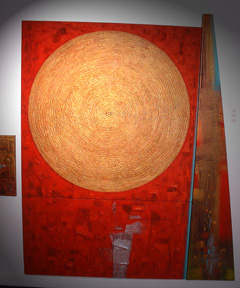
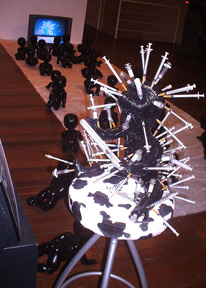
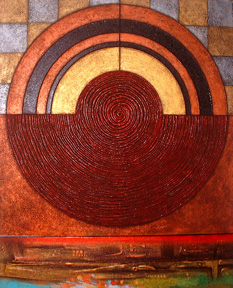
Abstract paintings pullulating with red and golden hues, black baby dolls crawling toward a television screen, and labyrinthine electronic gadgets with eerie lights sum up the “Technological Sublimation” of the award winning Filipino painter, installation and performance artist Ronaldo Ruiz.

In his particular installation “Technological Sublimation”, Ruiz came up with a concept how television and computer could distort the minds of the children and teenagers with his powerful imagery of baby black dolls watching another doll on TV monitor with iconic head and body stuck with syringes. The result is hauntingly surreal and mesmeric.

The artist never ceases exploring what technology could offer in his art, be it installation or live art performance. He manipulates and exploits technological gadgets to send across his message that technology could either build or destroy. It sounds trite and banal but Ruiz, like a shaman, had masterfully delivered his ingenuity with a powerful specter of reality in our society.

In contrast to his abstract paintings, his installations and live art performances are more dynamic and visually compelling. His paintings, on the other hand, evoke the balance of forms and colors, a conscious portrayal of yīn and yang. The subdued primary colors and refined patterning textures on canvas reflect the artist’s archetypal persona.

Surprisingly, however, the artist’s installation and performance art reveal the repressed side of his personality. His installation, for instance, discloses his inner self dashed with satirical sentiment and existential angst. The unrestrained histrionic portrayal of his three-dimensional pieces serves as a liberating device of his inner struggle as an artist of incalculable vision and eloquence.

To sum, the art of Ronaldo Ruiz invites the viewers to immerse into his own world of harmony and disorder. At times, his art can be visually appealing, evoking serenity within, but most often, his art perturbs and provokes bringing the viewers to their own reality, a reality numbed with complacency and cynicism.

© Danny C. Sillada

Tuesday, May 24, 2005

DANNY SILLADA: Images Upon the Rocks

images upon the rocks
By Carmencita H. Acosta
What’s On & Expat, May 22-28, 2005

Poetry of Nails & Blood: A Tribute to Pope John Paul II, 2005
Nails, Acrylic & Rubber Paint on Board & Metamorphic Rock, 50 X 40"

Poetry of Nails and Blood: A Tribute to Pope John Paul II, 50 X 40

Danny Sillada uses a unique medium on which to paint his abstract images. He shuns the conventional canvas and chooses, instead, metamorphic rocks as the recipients of the colors and images that he conjures up in his moments of artistic expression.

Imagination is the main ingredient of his paintings executed through the years and which had its beginnings many summers ago when as a growing lad in Mindanao he would watch his father create beautiful pieces of furniture in the carpentry shop.

Inkblot A by Danny Sillada, 2005
Acrylic on Canvas, 40 X 30”
12. Inkblot B
Copyright © 2005.

Sillada would pick up the pieces of paper that his father used to blot out stains from his tools. The curious boy would hold the discarded papers against the sunlight and see, not unsightly marks but symbols of reality: sometimes a human figure or a landscape; at other times, perhaps a tree or a flower.

Ecumenical Movement: A Tribute to Pope Benedict XVI, 2005
Acrylic & Rubber Paint on Metamorphic Rock, 50 X 40"
Ecumenical Movement: A Tribute To Pope Benedict XVI, 50 X 40
Copyright © 2005.

This experience has influenced his present collection of Rorschach-like inkblot images. The artist bids us to do as he had done years ago: to see symbols of real life in images, this time upon the rocks.

ffffffffffffffffffffffffffffffffffffff

the sensational ouevre
of the former man of god

By Reesy Garcia Ferrer

A One-Man Show at Ricco-Renzo Galleries
Manila, Philippines

Mystery of the Cross by Danny Sillada, 2005
Nails, Acrylic & Rubber Paint on Metamorphic Rock/Board, 40 X 30”
9. Mytery of the Cross
Copyright © 2005.

Poet, painter, philosopher, art critic and a former seminary formator Danny C. Sillada mounts his latest works, “Everything and Nothingness”.

Utilizing an expensive metamorphic rock or slate as a medium, his art has evolved into a more abstract and contemplative form. Albeit, his paintings are still in the surreal mode, he employed Rorschach-like inkblot images in relation to Sigmund Freud’s Psychoanalysis on id, ego and superego.

The inkblot series has a seeming playful and child-like quality. The viewer cannot help but take a second look at the perturbing imagery, as it offers a poignant and peculiar encounter of one’s psyche and subconscious. As a result, the psychology charged descriptions leave an indelible mark in one’s mind, and stir uneasiness and emancipation all at once.

Inkblot 04 by Danny Sillada, 2005
Acrylic & Rubber Paint on Handmade Paper/Board, 20 X 20”
Ink Blot Series 04, Acrylic on Paper, 2005
Copyright © 2005.

Sillada’s two paintings, for instance, titled “Metamorphosis” and “Adam & Eve” seem to appear as photo negatives or slides. His whimsical portrayal of imagery and symbolism is further enhanced by free-flowing strokes and unrestrained lines cascading on the sheen of metamorphic rock and handmade paper.

The resultant images of his works, according to the UP professor and art critic Reuben Ramas Cañete, are culled from manifold, eclectic sources, as diverse as his biographical experiences, exploring the depth of his tortured subconscious by juxtaposing the relationship between symbolism and experience.

Adam & Eve I Danny Sillada, 2005
Acrylic & Rubber Paint on Handmade Paper/Board, 20 X 17”
Adam and Eve, Ink Blot Series, Acrylic on Paper, 2005
Copyright © 2005.

His 6th one-man show entitled “Everything and Nothingness” is slated to open with cocktails on May 26, 2005 at Ricco-Renzo Galleries, at LRI Business Plaza, 210 N. Garcia St. (formerly Reposo), Bel Air II, Makati city, Philippines. For inquiry, please call at Tel. Nos. (632) 898-2542 to 43, Telefax (632) 898-2545 and Email at ricco_renzo@yahoo.com.

Friday, April 22, 2005

Cid Reyes: The Parallelism of Art & Women

Cid Reyes’ Demoiselles de Manille

"Cid Reyes, like a passionate lover, extols women to the heights with respect and adulation, and places them like goddesses in his aesthetics. His women are self-assured, oozing with dynamism on the surface of his canvas, bedecked with undefined forms and brilliant colors."

Buena Familia by Sid Reyes, Acrylic on Canvas, 2005
Buena Familia, Acrylic on Canvas

The essence of a woman transcends beyond space and time and like a seasoned wine, the older she gets the more she defines and completes the meaning and beauty of being woman. However, like men, she has her own conquest too, that is, to be constantly desired and adored rather than deserted like an object when youth and physical beauty wilt away.

Cid Reyes, like a passionate lover, extols women to the heights with respect and adulation, and places them like goddesses in his aesthetic creation. His women are self-assured, oozing with ineffable power on the surface of his canvas, bedecked with undefined forms and brilliant colors.

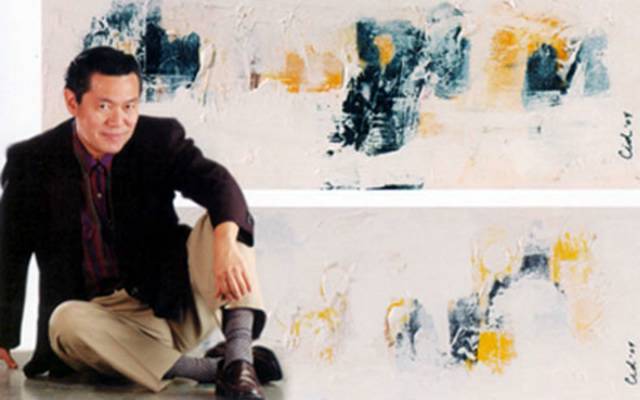
Departing from his whitish abstract paintings, Cid Reyes ingeniously combines figurative and abstract elements: the juxtaposition of female figure emerges as muse or goddess, more imposing than the brilliant and craggy surface of his canvas.

Equally thought-provoking is how he redefines the parallelisms of art, literally and figuratively, and the role of women in his aesthetics.

Tres Marias by Cid Reyes, Acrylic on Canvas, 2005
Tres Marias, Acrylic on Canvas

Here, his art raises a discursive proposition in redefining the role of women in our modern society apart from her domestic role as a mother, a wife or a daughter. A woman, for instance, is not confined to a limited function much as art is not restricted to a particular style or movement. Both have endless possibilities of becoming in what the Greek philosopher Aristotle posited in his “Act and Potency”.

At the outset, art transcends beyond space and time in as much as the role of a woman does. Art is inexhaustible, per se, but it is also limited within the realms of the artist’s creative visions. The more an artist discovers the uncharted bastion of creativity, the more he or she becomes.

In essence, it is the inexhaustible possibilities of art that makes the artist constantly evolve in the process of art-making as a woman does in her indispensable role in the post-modern society as career woman, a mother, a wife or a lover.

Poetic and metaphorical, the suite of Cid Reyes’ Demoiselles de Manille poignantly appeals to the sensual perception of the viewers, stimulating the human reason and emotion. It is metaphorical because it addresses the definition of women in the post-modern society; poetic because it reasserts the symbolic role of women within our culture and society.

Similarly, like the boundless possibilities of art and the unrestricted role of women, the artist’s quest for meaning and self-actualization goes beyond the mere functions as he relatively excels in all his endeavors

La Viuda, Unica Hija by Cid Reyes (Acrylic on Canvas, 2005)

La Viuda, Acrylic on Canvas Unica Hija, Acrylic on Canvas


As art critic and author of several art books, the man’s austerity and discipline to his multi-profession pursuits is amazingly extraordinary. Assuming different roles as executive in advertising, art writer, author and painter par excellence, elevate him to the status of a superhuman literally and figuratively.

How can the man be so creative in his art, write a regular art column on the daily paper, launch a coffee table book occasionally, and work full-time as an executive in one of the leading advertising agencies in the country?

As a painter, he is constantly contriving a fresh and dynamic expression of his art. The artist is restless until his creative power is exhausted on his canvas and, then, he starts all over again. His creative passion is more assertive though on the dynamic textures of his canvas than in the presence of this gentle and soft-spoken artist.

Equally compelling is his style of art writing and criticism, in which he masters the lucidity of inductive and deductive reasoning in a way that an ordinary person understands. In similar manner, occupying a higher position in the corporate world is both mentally and emotionally exhausting especially of one is sharing a responsibility of running the company.

The bottom line and the competitiveness in the business world lie on the competitiveness of the leaders and their moral responsibility in maintaining the quality of services to the client and to their employees.

Portrait of Cid Reyes by artist Camille Dela Rosa, Oil on Canvas, 2004.

Photo Courtesy of Camille Dela Rosa. Posted by
Hello

Cid Reyes, as the Vice President of an advertising agency, possesses the natural quality of a leader and goes out of his way by letting his subordinates come out their best creative outputs. He has his own style of leadership and his unique way of dealing with people resonates with his creative thinking.

Like the aesthetic quality of his art and writings, he infuses a creative style of management in his works, a unique quality that any corporate company should imbibe and practice.

Akin to the parallelisms between his art and his subject, the artist himself is not bracketed, in philosophical sense, to his facticity as an art critic or a painter or a corporate executive. He goes beyond all these labels and unveils himself to all the inexhaustible possibilities that a man can become within the span of his existence.

Cid Reyes is simply a creative artist of magnificent vision, a deep thinker that possesses the qualities of a Renaissance man.


© Danny Sillada

____________________

Cover girl, Debutant by Cid Reyes Acrylic on Canvas 2005)

Cover Girl, Acrylic on Canvas Debutant, Acrylic on Canvas

Sunday, January 09, 2005

CID REYES: Nights in White Satin

nights in white satin
the vision of an insomniac

Photo by Jose A. Ibay. Graphic by Pia Layoso, 2004.Posted by Hello
“Periods of happiness are blank pages in it, for they are periods of harmony – periods when antithesis is in abeyance...”
German philosopher Hegel, Georg Wilhelm Friedrich (1770–1831)

A journey characterized by an insomniac’s dark passage, Cid has created masterpieces from inner visions, extinguishing his restive thoughts and passion to a more defined quest for artistic meaning.

His art emerges from within, to an unusual extent, and equally compelling as those written prose and philosophical essays by a Romanian philosopher E.M. Cioran, who suffered from the same nocturnal restlessness, and whose body of works are laden existential angst, but extolling the grandeur of life.

The inner vision of Cid Reyes searches its own light and reason amid its nocturnal environment। His inability to lull in dreams forces his mind and body to create a suite of riveting works, which he called – the Night Visions. And the images radiate and beckon from a distance defying the principles of po-mo (post-modern) art.

Vision II by Cid Reyes, Acrylic on Board, 2004

Photo by Danny Sillada, Copyright © 2004. Posted by Hello

While the contemporary generation of Filipino abstractionists tramp toward the Oriental and Western concepts of abstract art, Cid Reyes traverses, though still within the vein of abstraction, in the opposite direction - the antithesis of bleak and darkened surface of po-mo abstractionism.

By principle, Abstractionism is a deconstructive art movement, which emerges from the ugly face of World War II, as a protest to the angst-laden aesthetics of the period. From there, it evolves and continues to mutate in the present in a world of virtual reality and technologism.

In essence, the post-modern art today is relatively remote and distant. It alienates man from a bleak reality, a haunting reality reflective of his ambivalent and fast-changing society: bold, radical and, at times, irrational.

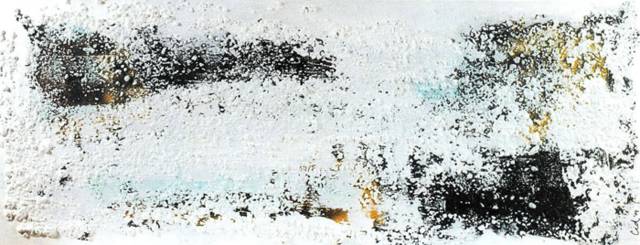
Cid Reyes bridges the gap of that alienation by bringing back the consciousness of his viewers to the metaphysical meaning of color, the color of white symbolizing the sense of wonder, innocence and beauty.
Mixed Media on Canvas, 2004

Photo by Jose A. Ibay. Posted by
Hello

The whiteness of his painting epitomizes the essence of purity and harmony on a pallid plane richer with forms and textures. His canvas is like a satin night without darkness, a night without walls or barriers, like the wings of angels reaching out to the laden souls with gentleness and compassion.

As the foremost art critic and top executive in the leading advertising agency in the country, Cid Reyes is a highly respected painter among his contemporaries. His creative output as an artist is equally comparable to his achievements and contributions to Philippine art as critic and historian.

The development of his art is inherent as a gift and its fruition is borne out of necessity from those restive nights, which he transmogrifies into a more meaningful aesthetic pursuit.

Similar to the Biblical account of creation where God created light from the void of darkness, Cid Reyes in his dark sleepless nights, assiduously labored and delivered the sensual and magical beauty of his creation.

Portrait of Cid Reyes by Camille Dela Rosa
Oil on Canvas, 2004

Photo Courtesy of Camille Dela Rosa. Posted by
Hello

Curious eyes could dither and linger behind those mystical pallid textures and colors; how one hungers for more within the boundless surface of his canvas without being too intrusive in his nocturnal passage from darkness to light.

Cid Reyes' 10th One-Man Show, The Crucible गैलरी SM Mgamall A, Level 4, Mandaluyomg City, Philippines


Photo by Jose A. Ibay. Graphic by Pia Layoso, 2004. Posted by Hello
© Danny Sillada