Tuesday, March 01, 2005

CARLO MAGNO: One of the Leading Filipino Abstractionists

FROM REALISM TO ABSTRACTIONISM
On-going One-Man Show at BMW Prestige, BMW Philippines.
The exhibit runs up to March 10, 2005, Pasong Tamo, Makati, Philippines
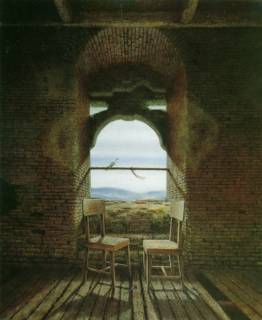
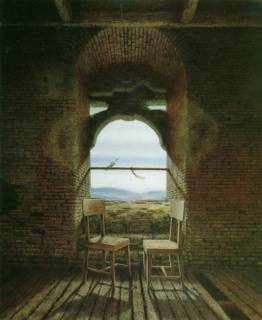
In his 1981 oil painting titled “Rendezvous”, realist painter Carlo Magno poignantly portrayed a nostalgic scene of lovers’ meeting place – an old church – a visual allusion to the Philippine classic Kundiman song “Lumang Simbahan” popularized by Larry Miranda.
Rendesvous, 1981, Oil on canvas by Carlo Magno.
Reprinted from the book "A Century of Realism in Philippine Art"
written by Manny Duldulao. Posted by Hello.
Rendered in a romantic chiaroscuro, the painting depicts an interior of the uppermost floor of the belfry with a huge imposing window at the center as the source of cascading light. Close to the windowsill are two wooden chairs facing each other and in-between, a single fresh rose lying on the jagged floor.

Based on the visual narrative, one can surmise that one of the lovers failed to come at the rendezvous, probably the woman, as indicative of an abandoned flower that was deliberately dropped on the floor to show the lover’s frustration to his beloved. However, one creature is visibly present at the scene – a dove standing patiently on the rail across the window with its slightly exaggerated long neck as if it were looking at a distance waiting for someone…

This emotionally charged imagery is only one among the countless realistic paintings of Carlo Magno who, for 22 years of his artistic career, has masterfully portrayed images from the detailed depiction of old churches and houses to the intricate and dramatic interplay of lights and shadows of the interiors.
Interior, 2000, Oil on canvas by Carlo Magno.
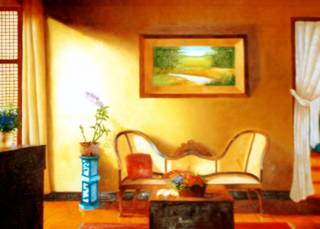
Photo by Danny Sillada. Copyright 2003. Posted by Hello

Today, Carlo Magno has dramatically metamorphosed from his two-decade pursuit of realism into a more profound search of esthetic expression. The deconstruction of forms and colors in his works, for instance, surprised his collectors and followers alike – how he reinvented his artistic style from realism into a more challenging field of abstractionism. The dramatic change of his creative output is remarkably groundbreaking which can be ranked side by side with the foremost Filipino abstractionists such as Lao Lianben, Raul Isidro and Gus Albor, to name a few.
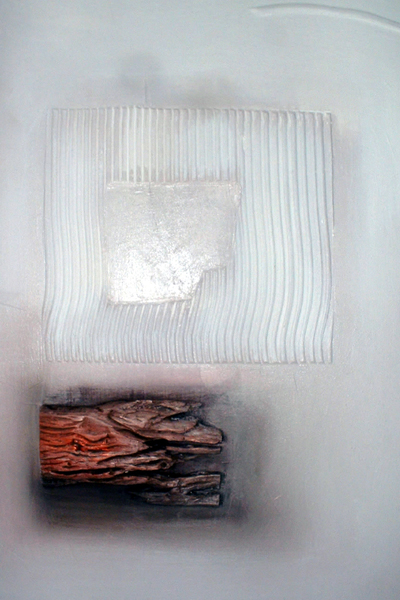
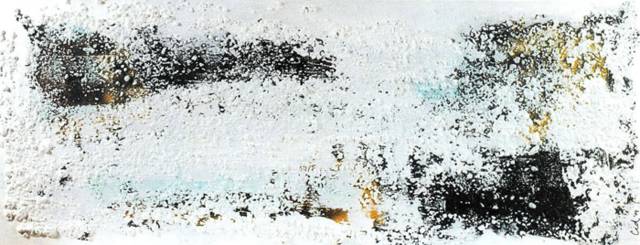
Untitled, 2004, Mixed Media on canvas by Carlo Magno.

Posted by Hello

When asked why radically spun out his art into a more daring genre, he reluctantly rationalized that he wanted to explore all the esthetic possibilities before the twilight of his artistic journey. He was, of course, alluding to some of his contemporary artists who, in one way or another, confessed that they wanted to create something different in their art before their creative passion ebbs away.

Conversely, the current oeuvre of Carlo Magno is, distinctively, the antithesis to his previous portrayal of realistic images. His forms and colors are literally diffused and melted on the surface of his canvas. The visual illusion of lights and shadows has been altogether defaced - the pictorial climax vanishes, and the flattened surface becomes the epitome of his inexhaustible esthetic interpretations.
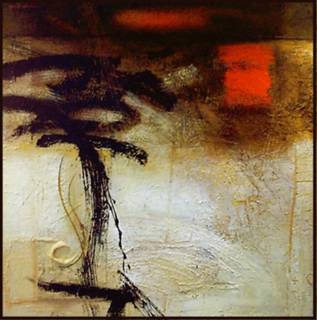
Eternal Tree, 2004, Mixed media on canvas by Carlo Magno.

Posted by Hello

In his crimson works, for instance, the thick color of deep red has been inescapably spread out in every corner of the canvas. At the center, an undefined form is minimally embossed, almost invisible yet protruding, creating an illusion of dynamism amid the opaque surface of the painting.

Windblown (Triptych), Acrylic on banvas by Carlo Magno, 2003.

Posted by Hello

Equally arresting, is his five-foot tall triptych where the undulating streaks of black and calligraphic lines, in contrast to the vermilion-toned background, are running across at the upper and lower portions of the picture, a reminiscent of Jackson Pollock’s dynamic paint drippings.
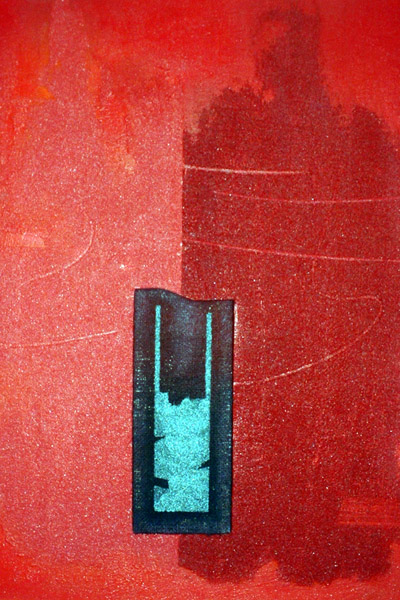
Some of his works are less jarring in form and color, but they have all the elements of unconstrained passion creating a bleak and formless poetry. And one could feel that sense of timelessness reverberating throughout the naked surface of the canvas.

Untitled, 2003, Acrylic on canvas by Carlo Magno.

Posted by Hello

Carlo Magno’s breaking out from the safe zone of his aesthetics is, preemptorily, a welcome precedent to most Filipino artists who have shared the same predicament of being confined from one’s style and from the dictate of the art market. For every artist has a dream and a vision to trudge upon the uncharted bastion of his esthetic creativity. He is hampered, however, to take a single stride lest he loses his artistic identity and eventually, his source for subsistence.

Carlo Magno, on the other hand, has proven himself that there is no risk of reinventing oneself as an artist if it is geared toward a more meaningful and creative pursuit. Surprisingly, the monetary success of his exhibitions as abstractionist painter is enough to prove that an “identity” of an artist to a particular genre is only accidental. What really matters is the persistence to create and the unremitting desire to be creative without confining oneself to the “formulaic versions” of one's style and techniques.

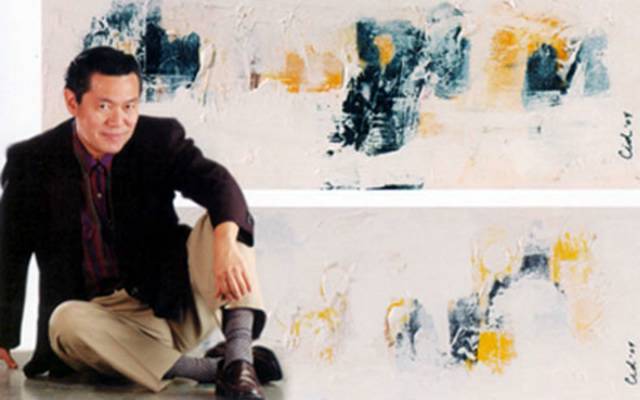
Carlo Magno
Photo by Danny Sillada. Posted by Hello.

Along with his transformation, Carlo Magno embraces and recognizes the unlimited possibilities of post-modern art, where the concept of Aristotelian’s poetics, which is imbibed by Philippine culture, is dead. It belongs to the Greco-Roman art of the past, and what is tangible is here, the art of our time as reflected by our fast-changing society - bold, radical and, at times, irrational.
Copyright © 2004 by Danny Sillada [δακασί].

Thursday, February 10, 2005

TED LUNA: The Symphony of His Art

The Symphony of Ted Luna's Art

"His art becomes a visual music itself, mimicking the poetic movement of objects and human body through the rhythmic flow of his forms and colors..."

When Silence is Golden, Digital Art by Ted Luna.
34 When Silence is Golden  L

As Kandinsky captured music through his abstract juxtaposition of forms and colors, Ted Luna’s aesthetic goes beyond the conventional norms of art making. By crossing over between abstraction and realism, he is creating an optical rhythm and the lyrical tones of figures and colors.

His art becomes a visual music itself, mimicking the poetic movement of objects and human body through the rhythmic flow of forms and colors either on digital prints or through his compelling images on canvas.

(1) Deja vu, (2) Deep Calls Unto Deep, digital Art by Ted Luna
08 Deja Vu  L 17 Deep Calls Unto Deep L

In his “Deja vu”, for instance, he compellingly captured the synchronous and sensual movements of forms and female figures like a flowing river, gentle and placid. At another instance, in his “Deep Calls Unto Deep”, a female nude figure defying the gravity in an oblation-like gesture, stretches her arms toward the sphere of light as if surrendering herself to her creator. The histrionic gesture of female figures is almost playful yet poignant and pensive.

The spatial background of his subject provides a theatrical contrast of space and movement that one could almost feel the symphony of music and the movement of figures resonating within the rectangular frame of his artworks. Equally transfixing is the fluidity of his colors on digital art prints rendered in an almost abstract form yet retains their own indispensable function in defining the essence of the entire aesthetic composition.

Synchronicity, Digital Art by Ted Luna
30 Synchronicity  L

In his depiction of “Synchronicity”, the artist is trying to capture the multi-colored lines converging around the female nude as if emitting energy of the woman, and the latter in a playful gesture, tossing up an undefined sphere with care and gentleness. The picture reflects the essence of a woman, her fragility and vulnerability, her strength and her power. It is like the song of a woman in her bare self, open and unrestrained.

Dream-like and mystical, Ted Luna’s juxtaposition of images are never dull but pullulating with sensual feelings, and that sense of childlike inquisitiveness rouses the viewers to go further into the fantastic world which the artist wishes to convey; a dreamland that anyone wishes to go and be real with oneself in peace and harmony.

Ted Luna, like the gentility of his presence, is the master of visual melody and the poetic movement of figures and colors, an inherent quality from a man of God who attunes himself with the rapture of spirit in his art, and his art becomes a metaphysical quest for the spiritual and the mystical.

Before becoming a multi-media artist, Ted Luna entered the Baptist Theology Seminary in the Philippines, a time where the call to serve God for the young Ted was persistent in his heart. After some time, he took up Fine Arts majoring in painting at the Philippine School of Music and Fine Arts and later, became a University scholar at the University of the Philippines, School of Fine Arts, majoring in Studio Arts.

Rest, Pastel on Paper by Ted Luna
19 Rest  L

It was only in 1985 that he began painting professionally and participating in different art activities in the Philippine art scene. It was also during this time that he garnered awards and accolades for his artistic achievements. He became a three-time grand prizewinner at the Philippine School of Music and Fine Arts and a recipient of the Art Excellence Award in 1989, a prestigious Metrobank Young Painters Annual Competition.

His works have been exhibited in the Philippines, in the neighboring Asian countries, Middle East and in Sheffield, U.K. His most important exhibitions are “Celestial Playgrounds” in 1989 at the Madrigal Center, Philippines, “Brushstrokes Strings, and Satin Shoes” (with Arnel Borja) in April 2000, a two-man show at the famous CCP or Cultural Center of the Philippines. He had exhibited also his “Celestial Playgrounds” in November 2003 at the L. A. Workshop Gallery and the “Rhythm and Hues” in December 2003 at the CCP, Philippines.

Copyright © 2005 Danny Sillada.


(1)Siamese Surfer, (2) Echoes, Digital Art by Ted Luna
Siamese Surfer v2 sm Echoes L

(1) Dream Catchers, (2) The Jolly Good Fellas, Digital Art by Ted Luna
Dream Catchers 36 The Jolly Good Fellas  L

(1) The Juggler, (2) Disclosure, Digital Art by Ted Luna
27 The Juggler  L 24 Disclosure L

Wednesday, February 09, 2005

BAL FORNALIZA: His Poetry of Forms & Colors

"...Ms. Marcy had found a loyal artist in the person of Fornaliza when, at times, she had no cash to pay the artwork, instead, the artist would trade kilos of rice for his painting – a reminiscent of Fernado Amorsolo’s younger years as a struggling painter."
Hamog, Oil on canvas by Bal Fornaliza, 2003

Photo by Danny Sillada (c) 2005. Posted by Hello


If one were to catch a glimpse at the rustic beauty of the province, the canvas of Bal Fornaliza is a window that invites the viewer to meditate upon the mesmerizing sceneries of the countryside environment.

Fornaliza’s pictorial rendition of bucolic life evokes a sentimental journey into an idyllic world where he came from. Through the virulent texture and translucent color of his canvas, he created a visual poetry that one could almost feel the gentle touch of summer wind, or hear the rushing waves of the sea…

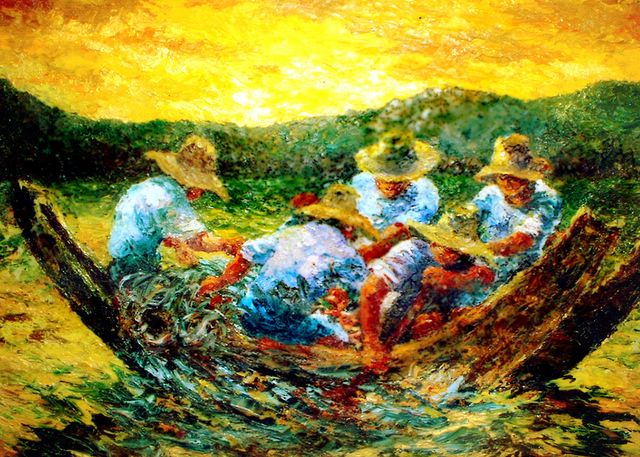
One of his visually compelling images is the Fishermen. Here, the viewer can immediately feel the pictorial tensions as reflected on the jarring colors and the histrionic portrayal of fishermen pulling the net. The craggy texture of oil color is converging at the center of the canvas – resonating the unified force of fishermen who are trying to untangle their catch for the day. What makes the imagery more dramatic is the undulating movement of the waves created by the heavily laden boat.

Fishermen, Oil on canvas by Bal Fornaliza, 2003

Photo by Danny Sillada (c) 2005. Posted by Hello

Equally impressive is his portrayal of Hamog, in contrast to his Fishermen, rendered in a tranquil and bluish monochromatic color. The intervening presence of white in-between the bluish tones create a lyrical space – silhouetting the leaves of the trees as though they were moving gently with the morning breeze.

In a similar manner, the presence of deep cadmium yellow in the middle of the picture, though signifying the morning light, serves as the gray area, an optical illusion in pictorial composition, to break the monotony of color pullulating through the surface of the artwork. Nonetheless, the picture is a visual haiku celebrating the timelessness and beauty of nature in a pristine world untarnished by environmental corruption.

Born on the 15th of May 1960 at Santiago, Bato, Camarines Sur, Fornaliza’s childhood is filled with poignant memories of his paradise-like town. As a boy, he grew up within the aesthetic atmosphere of his home; his father, Sofio Fornaliza, is poet, painter, musician and composer of Bicolano folk songs. As early as four years old - his mother - his first muse and inspiration as a fledgling artist, had collected his sketches of animals and paintings of rice fields and mountains done in watercolor.

The young Fornaliza’s artistic skill begun to flourish during his primary education when his teachers took notice and, eventually, exploited his precocious gift in the classroom. His talent had gradually developed when he began to compete in art competitions during his secondary and formal schooling, as he would consistently bagged citations and awards for his artistic excellence.

As a young lad, Fornaliza had already experienced the harsh realities of life in the province when he had to earn a living through fishing, farming and other manual works in his town. Later, the artist would frequently portray his favorite subjects, with such passion and authority, about the life of fishermen and the compelling images of rice field harvests.

In 1990, he came to Manila for a better opportunity when one of the members of his church Iglesia Ni Cristo, recommended him to the Fortune Tobacco Corporation in Manila as a resident artist in advertising division. During this time, he began to participate in several group exhibitions and later, had the opportunity to launch his first one-man show at Café Malate.

His association with different artists in Manila gave him a wider perspective in his style and technique when he met a senior artist, the late Virgilio Daclan, who influenced him to use the palette knife, instead of paintbrush, on his oil paintings. His new technique is conducive to his stylistic and painterly portrayal of rustic sceneries with bold and vibrant colors.

Then came the year 2000, the turning point of Fornaliza’s artistic career when he met an art patron, Ms. Marcy Supsup, an engineer by profession who saw the beauty of his works. She bought three paintings from him through the referral of a portraitist artist named Lorence. The chemistry between the art patron and the artist gradually developed when the latter found a lover of his works.

In turn, Ms. Marcy had found a loyal artist in the person of Fornaliza when, at times, she had no cash to pay the artwork, instead, the artist would trade kilos of rice for his painting – a reminiscent of Fernado Amorsolo’s younger years as a struggling painter.

Eventually, the engineer saw the potential of Fornaliza’s work in the art market that, instead of accepting a lucrative project in Singapore, she started to hang her collection of paintings at her modest boutique in Makati.

The lowly boutique gradually transformed into an art gallery and later, branched out at Ever Gotesco in Ortigas, which is known as Shamcey Gallery. Here, Fornaliza’s works continued to capture the viewers and the passersby and even mesmerized the heart of a certain balikbayan collector who promised the artist, through the Shamcey Gallery, a one-man show in the US.

Conversely, Fornaliza’s chosen genre, which is Impressionism, corresponds with his stylistic use of palette knife with thick and almost impasto composition on his canvas. His tropical colors are orchestrated in a typical manner peculiar to Philippine environment and its climatic condition.

Red, Oil on Canvas by Bal Fornaliza, 2003

Photo by Danny Sillada (c) 2005. Posted by Hello


Though Impressionism is a movement from the West, its humble beginning is traceable to Asian arts and culture particularly the Japanese’ and the Chinese’. Like for instance, Monet’s brushwork characterizes an almost calligraphic stroke on his small and large scales paintings. It was Vincent Van Gogh, however, who recognized the direct influenced of the Japanese calligraphy in his art as indicative of his short and bold strokes on the canvas.

Fornaliza, in his own right, assimilated these influences into his own oeuvre as if it were inherent in his environment in the countryside. As one of the qualities of Impressionism is the portrayal of the present, the artist contrived his own forms and colors with dynamism and unique pictorial composition.

Although some of his works are derivative from the masters like the figurative and painterly pictures of Amorsolo; Fornaliza, however, is already on his way of establishing his own esthetic identity as one of the most promising impressionists in the country.

Tuesday, January 11, 2005

DANDY ROY: From Martial to Visual Arts

dandy roy: from martial to visual arts
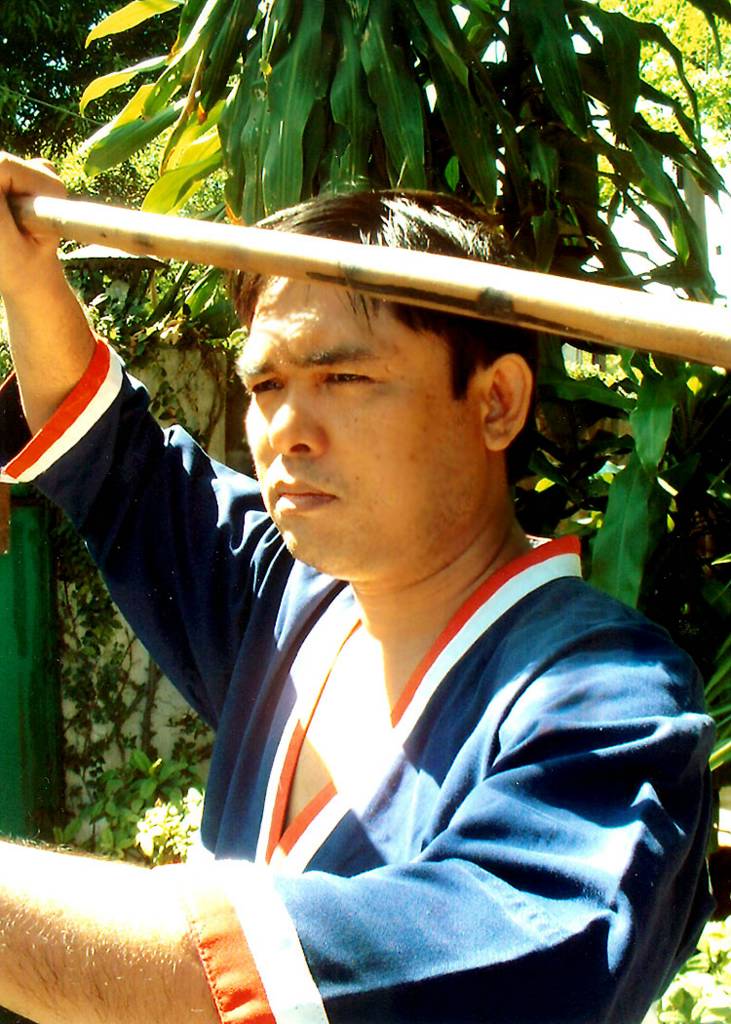
Dandy R. Morales a.k.a. Dandy Roy

Photo by Danny Sillada 2004. Posted by Hello
When his 1993 fight at a prestigious martial arts tournament in Phuket, Thailand did not materialize, this young master had to fight for subsistence in Manila. Stranded and disillusioned, like a typical provinciano who had gone astray at the heart of the metropolis, and with nothing in his pocket but a handful of dreams, he had yet to face the greatest fight of his life - a fight for survival - to assuage the pains of his hungering soul and stomach.

Instead of using his martial arts expertise in hunting for a job, he reluctantly dropped the “martial” but embraced the “arts” and from there, life was never the same for this award-winning eskrima master turned painter from Davao.

Dandy Roy’s still life paintings are teeming with geometric forms and colors. His esoteric subjects are reflective of his origin where ethnic foods are given with new meanings as they ingeniously appear on his canvas. The queer juxtapositions of tribal delicacies such as the lut (a bamboo tube where the native fish is cooked), the grilled uâbang (mountain shrimp), the steamed casili (eel), and other mouth-watering ethnic recipes are lusciously portrayed with dynamism on his canvas. The ensuing images are sensuously delectable and exotic.

Still Life, Acrylic on Canvas By Dany Roy, 2003.

Photo by Danny Sillada Copyright 2005. Posted by Hello

His journey begun from a remote town at the Eastern part of Davao province, a coastal town called Baganga, which is sandwiched between the lush mountains and the Pacific Ocean. In the 70’s and 80’s, this paradise-like place used to be a progressive town among other towns in the first district of Davao Oriental, where the logging concessionaires still stationed, reaping mercilessly the virginal forests of the entire district.

As a young lad, he benefited from the economic surge of his town by peddling his coco-wine (locally known as tubâ) to the logging workers. As a mananggeté or a winemaker, which he would proudly assert today, he supported his siblings and his own studies at school. His assiduous dedication to his humble profession at a very tender age was exceptional, sacrificing his personal needs and happiness for the betterment of his family.

He would rise early at dawn with cawit (bamboo container) fastened on his left shoulder and a sang’got (a sharp boomerang-shape blade) tucked on his waist, then climb as many coconut trees as he could to percolate the extracted juices from the cawit that was attached overnight to the sliced shoots of the coconut tree. The freshly harvested juices would then be processed and mixed with tungog, a red powder that served as coloring and taste enhancer, so that by seven o’clock in the morning, he was already off to school after delivering his gallons of product to the different tiangge (tubâ vendor).

His perseverance was finally rewarded when he graduated from high school out of his own dexterity and independence. He then dreamed of going to college in Davao City that was 800 kilometers away from his town. However, due to the financial constraint, his dream died before it could flourish. Disappointed and tired of his routine as a winemaker, he went into the mountains, not to become a rebel, but to live a hermitage life.

In 1981, after two years of living an ascetic life, he began to question the purpose and meaning of his existence. And like Albert Camus’ awakening, Dandy Roy suddenly found in him an ‘invincible summer’ when he decided to come out from his lonely delitescence and go back to his family and friends as a new and mature person. This time, determined to pursue his dream of studying in college, he began to unravel the beginning of his life’s journey in a distant place away from his land.

In the same year, he took up Electrical Engineering at the University of Mindanao in Davao City. However, his stint at the university was cut short when, in 1982, he decided to sail to the island of Cebu to shift in another course on BS Marine Transportation at the University of Cebu, then Cebu Central Colleges. Almost simultaneously, he also began his rigorous training in martial arts under the legendary grandmaster, Ciriaco Cañete, a world-renowned grandmaster in arnis and one of the founding members of Doce Pares.

Aside from his growing skills in kali and arnis, he went on further to learn in other fields of martial arts such as Karate, Judo and Jujitsu. In the following year, as a brilliant student with athletic physique, he was hired by his grandmaster as assistant instructor in the same university, which later, he would become a sports celebrity in the campus.

Then 1988 came, as the luckiest and the busiest year for this fully grown man who almost buried his dreams into the wilderness of his town. He bagged two championships in martial arts competitions being the national champion in Karate, open competition, under the Central Visayas Karate Association, and national champion in arnis, welterweight division, sponsored by the World Eskrima Kali Arnis Federation, which was organized by some Hollywood personalities (stuntmen) such as Dan Inosanto, Fred Degre Berg, Richard Bustillo, to name a few, headed by Grandmaster Ciriaco Cañete.

The Multi-Awarded Kali Master, Dandy Roy

Photo by Danny Sillada. Posted by Hello
His tours de force performance in martial arts earned him four different prestigious titles as Black Belt (4th Dan) in Arnis, Brown Belt (4th Kyu) in Judo, Black Belt (1st Dan) in Jujitsu, and Black Belt (1st Dan) in Karate. He was then one of the best and most sought-after instructors at that time, needless to mention his being the protégée of the grandmaster.

Meanwhile, in the same year, Lito Osmeña, then governor of Cebu, took notice of his growing popularity in martial arts, hired him through his grandmaster to train the Barangay Tanod members on tactical defense as part of the Department of Affairs’ program in suppressing criminalities in the city. Almost simultaneously, the Military Air Force hired him for his tactical combat expertise to train the Air Force officers and Air Force Police on Anti-Terrorist and Tactical Combat Defense program at Mactan Air Force, Cebu.

Despite the accolades and success, however, after a long strenuous routine as a martial arts instructor, his passion slowly wizened when he finally finished his studies in BS Marine Transportation in 1989. After making a difficult decision, he reluctantly left his post and his grandmaster with a heavy heart.

By 1990, he then went on in another journey, farther and away from his land, on an inter-island tramping vessel sailing through Philippine islands and, at times, in the neighboring Asian countries such as Malaysia and Singapore.

In the first quarter of 1993, after sailing for two years in the vast horizon of the sea, he anchored back home in his hometown in Baganga, Davao Oriental to see and embrace the people whom he dearly loved, the same people who gave him a reason to dream , which he eventually achieved through persistence and hard work. It was also in this town that he finally found the harbor that he had been longing in his heart, a lovely woman named Gemma, who began to fill the emptiness of his life.

Shortly after his brief vacation in his town, together with his newfound love and inspiration, he sailed again and this time, bound for Manila to prepare for an impending international martial arts tournament in Bangkok. In Manila, he was supposed to meet a friend; his would be teammate, Christopher Petrelle, who would be sponsoring his trip to Thailand. But Petrelle did not arrive to Manila because of a freak accident - a long jump as paratrooper in Australia that caused several bone fractures on his lower body.

With no adequate funds, he and Gemma stayed at their relatives, a known and established artist William Yu, at San Jose Village in Alabang. There, he also met his younger brother, Adrian Morales, an emerging artist who was an apprentice to William Yu. Consequently, as he began to associate with different artists in Manila, Dandy Roy slowly awakened his artistic passion and saw its potential as a source for subsistence.

After finding himself in the company of veteran artists like William Yu, Loreto Racuya and the late Isabelo Quiles, to name a few, being the odd man out, Dandy Roy finally joined them. As a fledgling artist then, he was agog to learn and relearn the rudiments of arts from the masters. One of them was Loreto Racuya who became his mentor in painting, and at the same time, his diligent student in martial arts particularly in arnis.

By 1997, Dandy Roy was lucky enough to meet the father of both struggling and established artists in the person of Atty. Mario Alcantara, the founder of Heritage Gallery, who saw the great potential in his art. At first, he was asked by his newfound patron to deliver one painting a week who, not only inspired him to paint, but also gave him tips on works that are saleable in the market. Later, Atty. Alcantara began to require him to submit more paintings, as the demand of his works grew bigger in the market.

He woke up one day in disbelief, as if in a euphoric dream, when he realized that his paintings had already been circulating in the market - being sought by art collectors and dealers alike. And who would believe either that this chameleon from terra incognita could metamorphose himself from a lowly mananggeté (coco-wine maker) to a martial arts expert and from a humble seaman to a promising visual artist.

Today Dandy Roy could only sigh with relief if he remembers his sinuous journey. He would rationalize that life is like an intricate process of making a coco-wine, or like martial arts where you have to counter-attack using your opponent’s own force, or like an ocean to be sailed and navigated, or like an empty canvas to be filled with forms and colors. As an optimist with undaunted dreams and vision, he still struggles to live day by day by conjuring up his art one at a time.

“My philosophy in life”, he said audaciously,”…is that, you have to make it happen, otherwise, nothing will happen to you!”

The newly-wed Dandy Roy with wife Gemma.

Photo by Danny Sillada. Posted by Hello

Monday, January 10, 2005

MANNY DULDULAO: Philippine Art Historian

THE NUDE IN PHILIPPINE ART
(A Conversation with Manny Duldulao)
by Danny Sillada


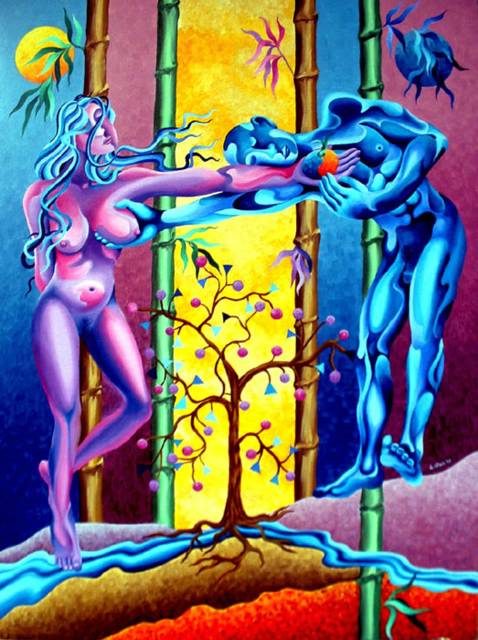
Adam & Eve, 2004. Oil on Canvas by Danny Sillada.
Collection by Mr. Eric Cruz. Posted by Hello

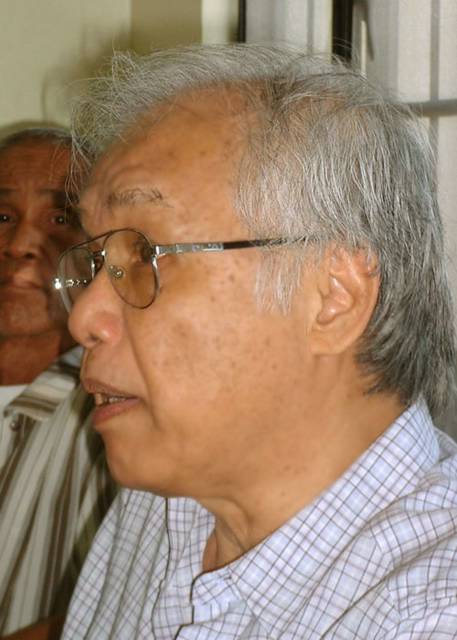
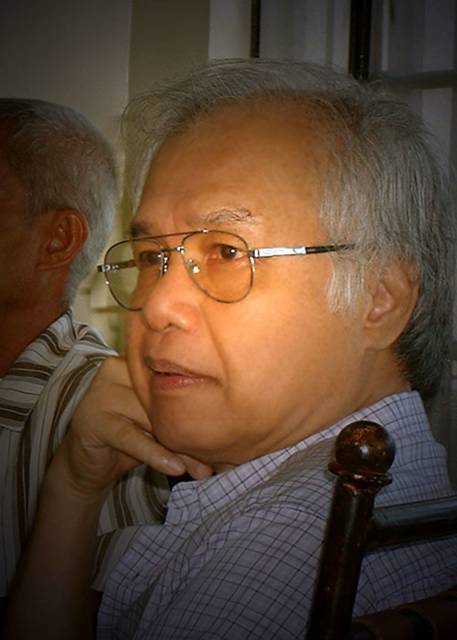
Manny Duldulao, art writer and historian, has written extensively on Philippine art and culture. As a self-made man, he is the only non-academe art historian who has written various books in the fields of Art and Culture and whose contribution is beyond compare among his contemporaries and the new generations of art writers.

Manny Duldulao

Photo by Danny Sillada, 2004. Posted by
Hello

Manny Duldulao is a legendary name within the circle of collectors - a Godfather to the Filipino struggling and established artists. Through his wisdom and dexterity, he immerses himself within the communities of Filipino artists; he helps and enlightens them to come out their best creative outputs that are reflective of Philippine culture and environment.

Tower of Eden, 2004. Oil on Canvas by Danny Sillada.


Photo by Danny Sillada, 2004. Posted by
Hello

A TOYM awardees (Ten Outstanding Young Men) in 1973, Manny Duldulao’s passion and energy never seemed to wane out after several decades of chronicling the Philippine art movements and activities. In his latest book, which will be launched in 2007 titled “The Nude in Philippine Art”; he introduces a fresh concept and development of Nude Art in the Philippines in the context of universal art.

In essence, he explores the attitude and concept of nude art in relation to the artists and their nude models, and the growing awareness of Filipinos especially the collectors toward Nude Art as a form of aesthetic expression.

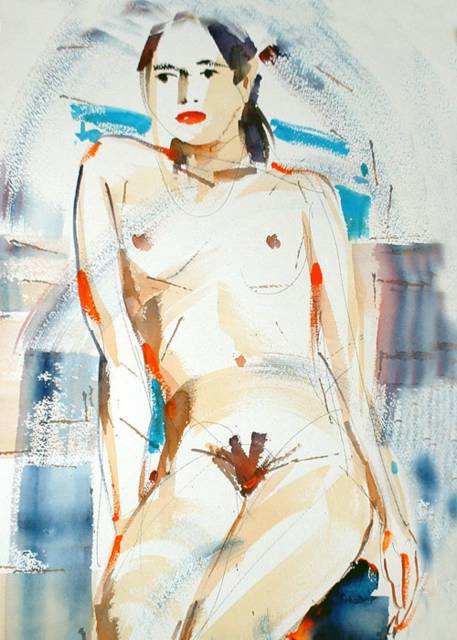
Nude I, 2004. Pastel on Paper by Allan Flores.

Photo by Danny Sillada, 2004. Posted by
Hello

THE DEVELOPMENT OF NUDE ART IN THE PHILIPPINES

The following conversation with the author in January 10, 2005 was a brief glimpse of “The Lives and Loves of Artists and Models” prior to its final publication and launching in 2007.

D.C. SILLADA: What is the main concept of your book on Nude Art in the Philippines?

MANNY DULDULAO:
The main objective of the book, “The Lives and Loves of Artists and Models”, is to place Philippine art in the context of universal aesthetics. That is the reason why I developed the book by showing masterpieces of nude paintings around the world from Spain to Parish to New York and, then, juxtapose them in the context of Philippine art movement.

All of the paintings that I am featuring in the book are full-blown artworks in the respective style of the Filipino artists. I don’t feature sketches or drawings because we cannot elevate Philippine art into a universal level if we are going to show minor pieces.

Nude painting in the Philippines is relatively a recent activity. It only came out in the 1980s and before that, from the 1930s to 1950s, there were not much movement especially in the academe like the University of the Philippines because they could hardly get a Filipina model to pose for the Fine Arts students.

D.C. SILLADA: What is the attitude and concept of Nude Art amid our conservative culture from 1930s through 1970s and 1980s onwards?


Desnuda, 2004. Oil on canvas by Danny Sillada.Collection by Mr. Paulito Garcia, Ricco-Renzo Gallery.

Photo by Danny Sillada, 2004. Posted by
Hello

MANNY DULDULAO:
Nude paintings in 1950s and 1960s, I would say, were practically academic. They were for studies of human anatomy along the lines of academic requirement, and not for the purposes of gallery exhibitions.

It was only in the 1970s with the organization of the Casa de Oro Group, which is currently known as the Saturday Group, under Alfredo Roces, Hernando Ocampo and Cesar Legaspi, when the nude as an art form began to emerge. Other artists took it from there like the group of Ernie Tagle; they took serious undertaking of giving the nude art form its due in the Philippine art movement.

I would, therefore, say that the flowering of the nude as an art form by itself began in the 1970s and blossomed around 1978 to 1979 and, then, started to have a heavy solid footing in the Philippine art market around the early 1980s.

Now, of course, anything goes... In fact, you can find nude session almost everyday and the artists are no longer looking at it as a form of exercise, but simply as an exploration of art form.

Marina, The Model. Photo by Danny Sillada, 2004.

Posted by
Hello

D.C. SILLADA: The Filipina nude models: how they respond in exposing their naked bodies in front of the artists, considering our conservative culture toward nudity?

MANNY DULDULAO:
In the 1950s, you could count on your fingers the girls who were posing in the nude, and they were mostly posing in academic classes like UP. However, it was only during 1970s that modelling became a profession, and one of the legendary pioneers is Nellie Sta. Maria.

When the girls realized that it was a serious undertaking and they could earn some good money in the process, many of them started modelling professionally for a moderate fee. Consequently, they were getting regular assignments especially with the group of Tagle, and they were common girls, not in the entertainment profession.

The girls were mostly students who put their trust on the integrity of the artists. One of them was a niece of the late art critic Lorna Revilla Montilla. She was fondly called Inday. One time, the model that they were waiting did not arrive so Lorna told her niece “O, Inday ikaw na lang ang mag-pose...”

It was the beginning of her modelling career that eventually prospered. Now, some girls took it as a profession: they are no longer embarrassed disrobing in front of the artists.

Today, Filipina movie stars pick up the modelling stints; so you can count on them as regular sitters. Girls like Tracey Torres, Julia Lopez, Rosanna Roces, Andrea del Rosario, Katya Santos, Honey Miller, the controversial Keana Reeves and Rose Valencia, they all posed in the nude sessions.

Nude II,2004. Watercolor on Paper by Gene de Loyola.

Photo by Danny Sillada, 2004. Posted by
Hello

D.C. SILLADA: What is your main thrust in the book in relation to the artists and their nude models?

MANNY DULDULAO:
After reading several literatures on nudes, I found out that art authors and historians concentrated on the human body as a source of art form. What I did with my book, I researched on the lives of nude models.

Like, for instance, the famous painting of Sandro Botticelli titled “The Rising of Venus”; I was able to gather enough information as to who the model is and the family where she belongs to. Likewise, the model of Édouard Manet and his controversial painting “The Luncheon on the Grass”: who is she and what is her name?

These are essentially the main thrusts of my book: the artists, the models and their symbiotic relationships that create a compelling history and developments of nude art from ancient time to postmodern period.


Nude IV, 2004. Pastel on Paper.


Nude II, 2004. Pastel on Paper by Nards Zepeda.

Posted by
Hello

"Manny Duldulao in his early 60's. His passion and energy never seemed to wane out after several decades of chronicling the Philippine art movements and activities."

Photo by Danny Sillada, 2004. Posted by
Hello

Sunday, January 09, 2005

CID REYES: Nights in White Satin

nights in white satin
the vision of an insomniac

Photo by Jose A. Ibay. Graphic by Pia Layoso, 2004.Posted by Hello
“Periods of happiness are blank pages in it, for they are periods of harmony – periods when antithesis is in abeyance...”
German philosopher Hegel, Georg Wilhelm Friedrich (1770–1831)

A journey characterized by an insomniac’s dark passage, Cid has created masterpieces from inner visions, extinguishing his restive thoughts and passion to a more defined quest for artistic meaning.

His art emerges from within, to an unusual extent, and equally compelling as those written prose and philosophical essays by a Romanian philosopher E.M. Cioran, who suffered from the same nocturnal restlessness, and whose body of works are laden existential angst, but extolling the grandeur of life.

The inner vision of Cid Reyes searches its own light and reason amid its nocturnal environment। His inability to lull in dreams forces his mind and body to create a suite of riveting works, which he called – the Night Visions. And the images radiate and beckon from a distance defying the principles of po-mo (post-modern) art.

Vision II by Cid Reyes, Acrylic on Board, 2004

Photo by Danny Sillada, Copyright © 2004. Posted by Hello

While the contemporary generation of Filipino abstractionists tramp toward the Oriental and Western concepts of abstract art, Cid Reyes traverses, though still within the vein of abstraction, in the opposite direction - the antithesis of bleak and darkened surface of po-mo abstractionism.

By principle, Abstractionism is a deconstructive art movement, which emerges from the ugly face of World War II, as a protest to the angst-laden aesthetics of the period. From there, it evolves and continues to mutate in the present in a world of virtual reality and technologism.

In essence, the post-modern art today is relatively remote and distant. It alienates man from a bleak reality, a haunting reality reflective of his ambivalent and fast-changing society: bold, radical and, at times, irrational.

Cid Reyes bridges the gap of that alienation by bringing back the consciousness of his viewers to the metaphysical meaning of color, the color of white symbolizing the sense of wonder, innocence and beauty.
Mixed Media on Canvas, 2004

Photo by Jose A. Ibay. Posted by
Hello

The whiteness of his painting epitomizes the essence of purity and harmony on a pallid plane richer with forms and textures. His canvas is like a satin night without darkness, a night without walls or barriers, like the wings of angels reaching out to the laden souls with gentleness and compassion.

As the foremost art critic and top executive in the leading advertising agency in the country, Cid Reyes is a highly respected painter among his contemporaries. His creative output as an artist is equally comparable to his achievements and contributions to Philippine art as critic and historian.

The development of his art is inherent as a gift and its fruition is borne out of necessity from those restive nights, which he transmogrifies into a more meaningful aesthetic pursuit.

Similar to the Biblical account of creation where God created light from the void of darkness, Cid Reyes in his dark sleepless nights, assiduously labored and delivered the sensual and magical beauty of his creation.

Portrait of Cid Reyes by Camille Dela Rosa
Oil on Canvas, 2004

Photo Courtesy of Camille Dela Rosa. Posted by
Hello

Curious eyes could dither and linger behind those mystical pallid textures and colors; how one hungers for more within the boundless surface of his canvas without being too intrusive in his nocturnal passage from darkness to light.

Cid Reyes' 10th One-Man Show, The Crucible गैलरी SM Mgamall A, Level 4, Mandaluyomg City, Philippines


Photo by Jose A. Ibay. Graphic by Pia Layoso, 2004. Posted by Hello
© Danny Sillada

Friday, November 26, 2004

JUN ALFON: Beauty Amid Troubled Paradise

BEAUTY AMID TROUBLED PARADISE
(THE ART OF JUN ALFON)


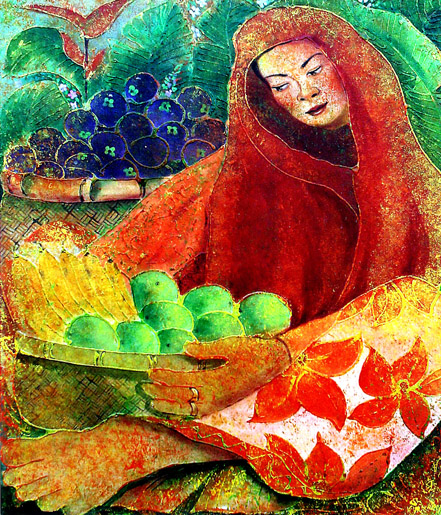
Fruit Vendor by Jun Alfon, 2004, Oil on Canvas
Photo by Mano Dela Rosa, 2004. Posted by Hello
Swinging between folk art and abstractionism, this prolific artist from Mindanao has masterfully explored both genres with ease and eloquence.

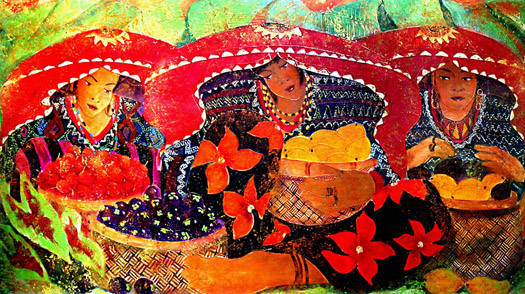
Known for the elegant and intricate portrayal of tribal women, Jun Alfon captured the true essence of Filipino art by depicting the multi-ethnic motifs of Mindanao’s diverse culture. His art seduces and mesmerizes the audience with the enchanting presence of his exotic women, bedecked with the intricate ethnic designs and vibrant colors, so entrancing that one could almost feel the drumbeat, the sound of kuglong, and the mystical dance steps of baylan.

Three Women by Jun Alfon, 2004, Oil on Canvas.

Photo by Mano Dela Rosa. Posted by Hello

As a folk artist, Jun Alfon is one of the the forerunners of Filipino tribal art on canvas. Growing up in the multi-cultural environment of Mindanao, which consists of Christians and Muslims, multi-ethnic tribal communities, the mestizos and the mestizas of Spanish descent and the migrants coming from different islands of the Philippines, Jun Alfon’s art is rooted within the complex convergence of cultures in his native land.

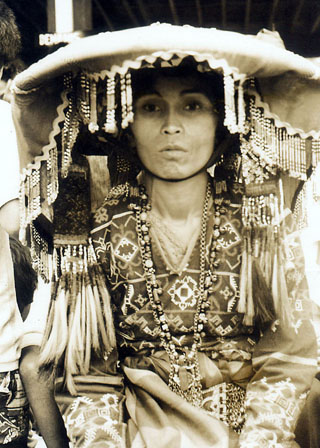
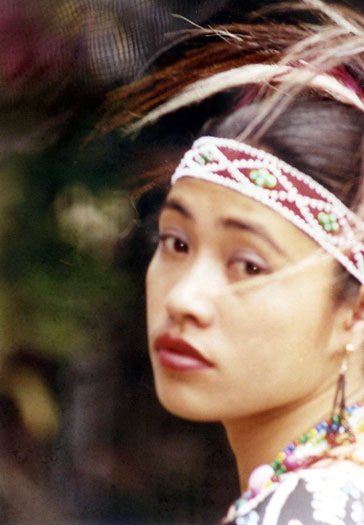
Tiboli Woman with Kuglong, Photo by Jun alfon.
Posted by Hello

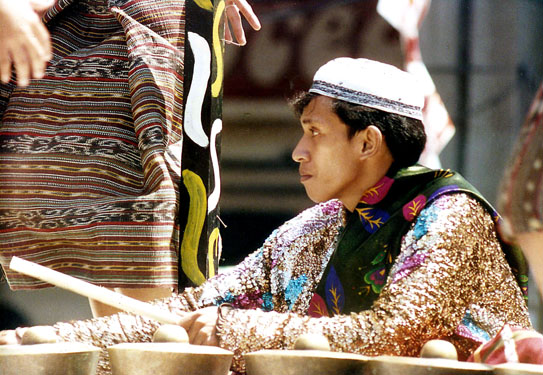
Aside from being a painter, the artist is also passionate about the multi-ethnic backgrounds of his people and their diverse cultural practices by chronicling them through the unflinching lens of his camera.

His photographs are equally compelling as his works on canvas. Unlike his paintings, however, his camera captures the essence of his subjects in a theatrical manner: the drama between his people and their cultural identities with dignity and elegance.

Kadayawan Festival, Photo by Jun Alfon.

Posted by Hello

As a photographer, he immerses himself with his subjects, a unique quality not common to photographers, whose relationship with the subjects is distinctly divided between art and professionalism.

Tiboli Woman, Photo by Jun Alfon.

Posted by Hello

Jun Alfon is also a portraitist whose mastery of pastel on paper renders a unique glance of character glowing with tonal values and colors. “Drawing…” according to neo-classicist Jean-Auguste-Dominque Ingress,”…is the probity of art”. Jun Alfon’s drawings and portraits go beyond the classical concept, as they are intimately warm and tangible, reflective of the artist’s personality.

In essence, the classical draftsmanship of his art is highly influenced by the intricate and complex tribal designs in Mindanao. Like for instance, the stylish headdress of the Tiboli, the geometrical designs of dagmay by the Mandayas, the colorful malong and tubao of native Muslims and other ethnic designs that are pullulating with exotic forms and colors.

Babaylan by Jun Alfon, 2004, Oil on Canvas.

Photo by Danny Sillada, 2004. Posted by Hello

Even in his abstract paintings, he consistently employs the tribal motifs and colors with suave and sophistication. In like manner, his abstraction is not confined within the canon of po-mo art but rather explores the relationship of other genre with continuity and dynamism. It is like an extension of his other mediums, rather than a departure from the cultural roots of his aesthetics.

Native Muslim, Photo by Jun Alfon

Posted by Hello
Swinging from one genre to another, Jun Alfon never loses the quality and aesthetic identity of his art. The dynamism of his creativity is traceable to his cultural environment in Mindanao - how art becomes an indispensable medium within the cultural practices and rituals of its people.

Conversely, the multifaceted art and culture in Mindanao is not static, but an art of action fillwd with rituals, festivities and celebrations. Generally, Mindanaoan artists, consciously or unconsciously, imbibed these influences on their art.

Muslim Women, Photo by Jun Alfon.

Posted by Hello

Art in Mindanao is synonymous with action infused with animism and ritual. Among the native Muslims and tribal communities, art is the manifestation of their daily lives and their lives are the soul of art, tradition and culture. Their intimate relationship with nature enriches that sense of dynamism and joie de vivre through the ceremonial dances and music, costumes and ritualistic performances. Nature is alive with spirits and art is the tangible expression of those spiritual and supernatural encounters with nature and spirit.

Contrary to the general impression about the belligerent environment of Mindanao due to some dissenting Muslim brothers and Christian rebels, Mindanao is like a paradise whose exotic beauty is teeming with magic and wonders. Her verdant lands and mountains, her crystal-clear streams and rivers, and her flora and fauna are natural wonders unique to this paradise.

Mansaka, Photo by Jun Alfon.

Posted by Hello

Mindanao is also known as the Land of Promise, needless to mention her wealth and beauty. But it is also the land of broken people and unfulfilled dreams because of political and economic convulsions, which the Philippine government failed to address for decades. Despite her brokenness, Mindanao remains a paradise yet to be explored and discovered by her own people.

Within a three-decade self-exile from Mindanao, Jun Alfon consistently tells the story of Promised Land through his art, as reflected on the intricate forms and colors on his canvas. His art emerges with no pretensions and speaks of, as it has always been, the splendor and beauty of his paradise.

Jun Alfon in his studio, Photo by Danny Sillada.

Posted by Hello