Sunday, December 17, 2006

RONALDO RUIZ & HIS TECHNOLOGICAL SUBLIMATION


The Art of Ronaldo Ruiz and His Technological Sublimation
By Danny C. Sillada


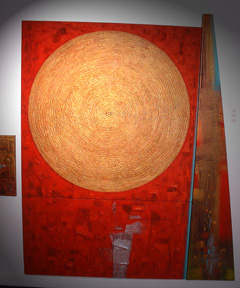
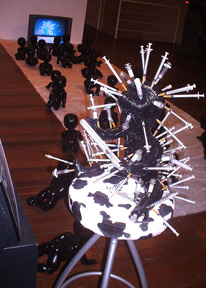
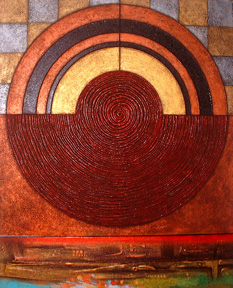
Abstract paintings pullulating with red and golden hues, black baby dolls crawling toward a television screen, and labyrinthine electronic gadgets with eerie lights sum up the “Technological Sublimation” of the award winning Filipino painter, installation and performance artist Ronaldo Ruiz.

In his particular installation “Technological Sublimation”, Ruiz came up with a concept how television and computer could distort the minds of the children and teenagers with his powerful imagery of baby black dolls watching another doll on TV monitor with iconic head and body stuck with syringes. The result is hauntingly surreal and mesmeric.

The artist never ceases exploring what technology could offer in his art, be it installation or live art performance. He manipulates and exploits technological gadgets to send across his message that technology could either build or destroy. It sounds trite and banal but Ruiz, like a shaman, had masterfully delivered his ingenuity with a powerful specter of reality in our society.

In contrast to his abstract paintings, his installations and live art performances are more dynamic and visually compelling. His paintings, on the other hand, evoke the balance of forms and colors, a conscious portrayal of yīn and yang. The subdued primary colors and refined patterning textures on canvas reflect the artist’s archetypal persona.

Surprisingly, however, the artist’s installation and performance art reveal the repressed side of his personality. His installation, for instance, discloses his inner self dashed with satirical sentiment and existential angst. The unrestrained histrionic portrayal of his three-dimensional pieces serves as a liberating device of his inner struggle as an artist of incalculable vision and eloquence.

To sum, the art of Ronaldo Ruiz invites the viewers to immerse into his own world of harmony and disorder. At times, his art can be visually appealing, evoking serenity within, but most often, his art perturbs and provokes bringing the viewers to their own reality, a reality numbed with complacency and cynicism.

© Danny C. Sillada

Saturday, August 26, 2006

WAWI NAVARROZA, AS I REMEMBER HER, THEN & NOW


WAWI NAVARROZA - musician, poet, performance artist, writer and a photographer has blossomed to a full-grown artist in her pursuit for highly sensitive aesthetics.

Three years ago I met this lovely petite girl at the opening of my exhibit titled “Surreality” in White Plains, then haven of the revived Philippine Art Gallery, one of the oldest galleries in the Philippines. She was vivacious with a goddess-like face teeming with life and passion. I didn’t know then what this lovely girl’s artistic life awaits her in the future.

In 2005, our path crossed again when I invited her to read my poems at the opening of my show titled “The Collection” at The Podium, Mandaluyong City. And it was also the time when I recommended her to the PIPAF Director Yuan Mor’O Ocampo for the 4th Philippine International Performance Arts Festival that was held in September 0f 2005.

At that time, I didn’t know that Wawi is the vocalist of a rock band named “The Late Isabel” and I didn’t know either that she is already a professional photographer, who had been winning awards from photography, one of which, from the prestigious AAP competitions. Wawi is still the same girl that I met two years earlier except that her new look resembles to one of the personas portrayed by Winona Ryder in the movie.

At the opening of my show at The Podium, Wawi performed my poems with a powerful imagery of a motherland, clad in semi-Filipiniana attire with the Red Cross symbol printed on her chest and a wreath of thorns around her head. She followed the red tape trail on the floor that was created by Moro Ocampo’s live art performance earlier in the event, as a segue to her own interpretation of my poems. The thrilling response of the audience was overwhelming.

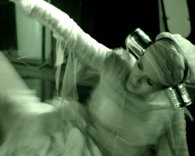
During the 4th Philippine International Performance Arts Festival that year, Wawi surprised me again with her riveting performance at the Dance Forum titled “Truth is Many and Lies in Between”. She danced like a gypsy wearing her uniquely designed attire with empty cans attached around her dress and between her head. Here, Wawi portrayed the plight of human relationship between sanity and insanity, reality and illusion, truth and lies. Her inner soul flowed like the gypsy’s ritual song resonating with her body movements - bizarre but mystical.

In her “Labyrinth” at Rajah Soliman, a durational performance of the same festival, Wawi once again enthralled the audience with her mesmerizing feat. She was wearing beige attire with hood; her face was covered with black veil while she was pulling the cart filled with household objects. One remarkable object on the cart was a lamp as though it was guiding her through a long, winding journey into a dimensional world.

With her natural sense of theatrical characterization and sensitive use of framing devices in her live art performance, Wawi emerged like a powerful “babailan” or shaman, provoking and engaging the ‘sore spots’ of her audience. Her haunting portrayal of symolic elements is reflective of her passion as a photographer, capturing not only the visual images of her performance but stories of her subjects in detail.

Today, I see Wawi as a delicate legendary flower in my land in Davao called “Itum na Buwac” or the “black orchid”; her smell spread out throughout the mountains and rivers, reaching out and healing the lonely souls through her aesthetic creation.

© Danny C. Sillada

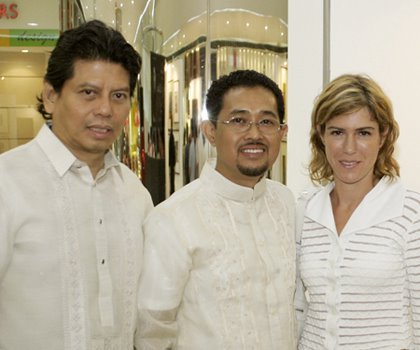
photos (from top to bottom): (1) wawi's poetry performance at my 7th one-man show at the podium, 2005; (2) Wawi & me at the opening of my 8th one-man show at art center, sm megamall, 2006; (3) wawi at dance forum, philippine international performance art festival, 2005; (4) wawi at rajah soliman, philippine international performance art festival, 2005; (5) wawi reading my poems at the opening of my 8th one-man show at art center, sm megamall, 2006.

Wednesday, November 16, 2005

Director Elwood Perez, Maui Taylor & Me in "Private Parts"

Maui Taylor & Me
Filmmaker Elwood Perez, the most rumored movie actress Maui Taylor and Me in “Private Parts?

Well, not really but it was my controversial painting “Menstrual Period in Political History”, which will be used as part of the play at the Music Museum in Greenhills on November 30 – December 1, 2005.

I thought, after a brief hiatus from the controversy in Philippine art scene, one of the contentious pieces that I exhibited early this year will be laid to rest forever in anonymity. Until a week ago, my good friend, a legendary and multi-awarded movie director, Elwood Perez, called me on the phone that he is going to use the artwork as icon of private parts, literally and figuratively, in his theatrical show titled “Private Parts”.


Director Elwood Perez, Myself & Paula Brillson.
At first I was hesitant to say yes, but later I realized that it was him and another friend Paula Brillson, a lawyer and media consultant from New York, who fought and stood by me at the height of my controversial one-man show at The Podium last July 2005. For one thing, it was too offensive, according to the mall manager, to the sensitivity of the Filipinos because of the outright portrayal of vaginal form. Second, it was a provocative artwork criticizing the political leadership of a female President of the country.

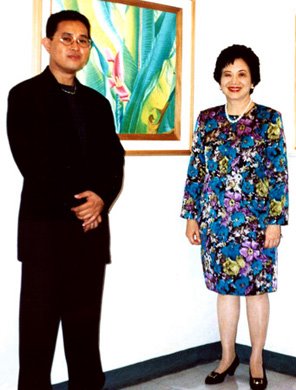
Me & the former Pres. Corazon Aquino in 1996.
It was also during the time of my exhibition that the former female president, Madam Corazon C. Aquino, went out from the comfort of her shell and led a massive rally at the Ayala Avenue in Makati protesting the present Madam President, Gloria Macapagal-Arroyo, to resign from her post because of allegedly electoral fraud that won her presidency with its infamous nickname “Hello Garci”.

Because of the irrational uproar on the vaginal form and the political content of my artwork, the rally of Madam Cory and the “Hello Garci” hullabaloo, my two prospective collectors, a Belgian and a Filipino-Chinese who were vying to own the “Menstrual Period in Political History”, withdrew from the reservation list because they don’t want their names to be dragged into the controversy.

Menstrual Period in Political History 1 The Cocoon of Life, 2001 Poetry of Nails and Blood
"The menstrual Period in Political History", mixed media on metamorphic rock (left), "The Cocoon of Life",oil on paper (center), and the "Poetry of Nails & Blood", acrylic and nails on metamorphic rock and board.

Ironically, these two female presidents (past and present) had, in one way or another, been connected to my art. Madam Cory Aquino had been a guest of honor in a group show that I participated in 1996 at the Eugenio Lopez Museum while Madam Gloria Macapagal-Arroyo owned my painting titled “The Cocoon of Life”, a gift to her by my aunt, Congresswoman Corazon Nuñez-Malanyaon, during the president’s visit in my town two years ago.

Fashion Model Avi Siwa
Meanwhile, visiting the rehearsal of “Private Parts” at the Viva Productions studio was exciting because I met another legendary and veteran movie director Behn Cervantes and, of course, Maui Taylor, and other casts of the play.

Talking of Maui Taylor, she is a very lovely cuddly petite young woman whose angelic face could be mistaken as an innocent girl next door. She is not a prima donna type of actress but down to earth, soft spoken, intelligent with mesmerizing presence.

Actor-producer Allen Dizon
In the middle of our conversation about art and philosophy, which eventually led her plan to purchase one of my works the “Poetry of Nails and Blood” for her condominium unit, Maui asked me to join her lunch at 5 p.m. (?) while other casts were still rehearsing. She was so hungry that she finished two meal-packs of scrumptious spaghetti served by Dennis Evangelista, the manager of movie actor Allen Dizon.

The “Private Parts”, written by another friend screenplay writer Jigz Recto, is a satirical take on the politics in show business and the dying "sexy movie" industry in Philippine cinema. The play is produced by actor Allen Dizon and his manager Dennis Evangelista; music by Jobin Ballesteros and choreographed by Bong Embile.

Fashion model/movie actress Wilma Doesn't.

The casts are director Behn Cervantes, the controversial movie actress who had been linked to the presidential son, Maui Taylor, actor and producer of the show Allen Dizon, Wilma Doesn't, Myles Hernandez, Ynez Veneracion, Avi Siwa, Vangie Labalan and Margie Sofia Rei under the direction of Director Elwood Perez and assistant dierctor Armando Reyes.

The “Private Parts” will be shown on November 30 – December 1, 2005 at the Music Museum in Greenhills, Quezon City.

© Danny C. Sillada

Tuesday, October 18, 2005

A NIGHT OF LIVE ART AT PENGUIN CAFÉ WITH CHUMPON APISUK by Danny C. Sillada


Chumpon Apisuk, photo by Danny Sillada © 2005.

The night had just started at 11 p.m. on the busy streets along the Remedios Circle in Malate. Metro hoppers – artists, poets, writers, corporate executives and young lovely women – flocked to one of the busiest bars on a Friday night in Manila.

One of those frequently visited bars by the artists is the Penguin Café – the haven of visual and performance artists, theater and dance artists, movie actors, poets and art enthusiasts. Chumpon Apisuk, founder of Asiatopia, an Asian Performance Art Festival in Bangkok, came and performed at the café with other Filipino performance artists headed by the founder and artistic director of PIPAF Yuan Mor’O Ocampo.

There were eight performance pieces that rapt the audience on the 14th of October 2005 – a one-night happening in honor of the legendary performance artist from Thailand – Chumpon Apisuk.

Performance Artists and their Live Art performances:

1. Ronaldo Ruiz “Revenge”
2. Yuan Mor’O Ocampo “Diaspora”
3. Danny C. Sillada “Sewing the Hole of Water”
4. Jethro Jocson “Drifting and Falling”
5. Mitch Garcia “Desserts/Stressed”
6. Lorina Javier “Submission to the Void”
7. Jeho Bitancor “Mirror Image”
8. Chumpon Apisuk “Five Actions of Body Performance”

RONALDO RUIZ's "Revenge"


Ronaldo Ruiz

Ronaldo Ruiz’s opening performance titled “Revenge” reexamines his trademark of sound using small electronic gadgets such as microphone, speaker, camera, electronic alarm and recorded sounds of frog and cicadas. As he moves his hands from one gadget to another, he produces different sounds creating an ethereal and discordant noise, resonating with the recorded nocturnal sounds of the frog and cicadas at the background.

One riveting gesture is the swinging of a small microphone near the speaker, creating a rhythmic sound in a circular motion, as if time and space converge in a g-force to create the poetry of sound and movement. On the other hand, there seem to be an internal incubation of crossness that was released inside the artist’s chest in the process of swinging the microphone, more liberating than the title itself “Revenge”.

Ruiz’s penchant for electronic gadget explores the sound like a conductor of an orchestra with his own hands. But unlike an ensemble of musicians, Ruiz has the control of manipulating the sound to his own liking in a random and spontaneous manner. There is a certain degree of playfulness in the process of his performance and his imagery evokes wonder and curiosity of a child.

Ronald 2
Photo by Danny C. Sillada © 2005. UGNAYAN Journal

YUAN MOR'O OCAMPO's “Diaspora”


Yuan Mor'O Ocampo

The second to perform was Yuan Mor’O Ocampo with his “Diaspora”. Here, Ocampo was tying the knots on the unused ribbons of medals, thus creating a long sequence of string with the color of the Philippine flag. He tied the other end of the string in one corner and the other end at the pillar located at the center of the bar. Then he asked the audience to tie the other ribbons on the string.

The dangling ribbons created an image of “banting”, which is typically used during the town fiesta celebration. Then, Ocampo began circling around the posts located at the center of the bar murmuring: “Life is hard, not here, not for me” until he completed wrapping the string around them.

Ocampo’s imagery of reality is powerful, addressesing the plight of 10 million overseas workers around the world and the knotted string dashed with ribbons symbolizes the convergence of overseas workers to make the Philippine economy afloat from the pit of perdition.

“Life is hard, not here, not for me” is like a Shaman's urgent call to reexamine our political and economic conditions; it is also a call for the overseas workers to bring back their broken dreams into their own homeland.

Moro 2
Photo by Danny C. Sillada © 2005. UGNAYAN Journal

DANNY SILLADA's Sewing on the Hole of Water


Danny Sillada

The third performance was done by this writer (Danny Sillada) titled “Sewing the Hole of Water”. With a bowl of water, I began to lay the white thread with silver strand through a large needle’s eye, and after pulling the thread in equal length, I knotted both ends.

Then, I started to sew the imaginary holes on the water. With my eyes focused on the bowl, I dipped my right hand fingers with needle and thread into the water and pulled it up gently into the air as if I was sewing a sack of rice. A minute later, a liquid leached into the air turning my fingers and the water into red: an image of blood appeared on the bowl of water.

‘Is there really a hole on the water?’ I asked the audience with rhetorical question. I explained that while there could be a space in-between the molecular elements that composed the water (hydrogen and oxygen), ‘It is impossible to see ahole on the water through the human eye…’ But that was beside the point. What I was trying to sew, if not to say, on the water was the rotten hole of our economic and political conditions, the rotten hole of our constitution and the rotten hole of our political leaders.

The transformation of water into an image of blood symbolizes the anguish and the predicament of Filipinos who could hardly see a light of hope from in our tormented society.

Danny 2
Photo by Ronaldo Ruiz (c) 2005.

JETHRO JOCSON's “Drifting and Falling”


Jetro Jocson

Jethro Jocson, the fourth to perform, used his body with his performance “Drifting and Falling”, as he literally threw his body face down on the floor and got up only to repeat the same ritualistic action. Standing straight in a meditative mood, Jocson employed the rest and motion movement where he would remain immobile for seconds in front of the audience then throw himself on the floor. His action created tension in-between silences as the audience held their breath in his act of falling on the ground like a wooden pole.

“A man’s struggle,” Jocson said, “is in-between falling and drifting away from himself.” Surprisingly, Jocson is one of the youngest performance artists in the group and he seemed to be addressing his own struggle as a young performer. In similar manner, it could also happen to any artist at the moment of stasis that he or she can become a prisoner of success or failure. An artist can drift away or wallow between these two extreme conditions instead of moving forward, but one can always rise above from the trappings of one’s inflated or deflated ego.

Jethro 1
Photo by Danny C. Sillada © 2005. UGNAYAN Journal

MITCH GARCIA's “Desserts/Stressed”


Mitch Garcia

“Desserts/Stressed” was the fifth performance presented by Mitch Garcia. Sitting in front of the table with spoon and ice cream placed on the glass, she was relishing the sweetness on her palate. Every now and then, she would move her chair from corner to corner of the table as if she was trying to portray other imaginary persons eating with her. From time to time, she would wipe her mouth with unfolded tissue with an inscription of lipstick that said “Desserts/Stressed”. The two-word inscription was separated by a slash sign composed of the same letters but read differently with different meanings. When “Desserts” is read backwards, one can read “Stressed”.

Mitch Garcia’s performance is by no means an autobiographical feat about her diabetic condition. Suffering from diabetes in advantage stage, she struggles to balance her life and her career as an artist amid her pathological condition. When sugar diminishes in her body, she becomes weak and vulnerable to “stress” and to maintain the balance, she has to eat “sweet” food or inject insulin on her stomach to normalize the glucose level in her blood. Garcia’s performance brings her handicapped into a higher level of aesthetic pursuit and, as a performance artist, it becomes her own triumph.

Mitch 2
Photo by Danny C. Sillada © 2005. UGNAYAN Journal

LORINA JAVIER's “Submission to the Void”


Lorina Javier

In her satirical take on “Popular Religiosity”, the sixth performer Lorina Javier surprised the audience with her riveting performance titled “Submission to the Void”.

Clad with shiny purple shawl around her shoulders cascading down to her knees, she swallowed the rosary beads but leaving the dangling crucifix on her mouth; she knelt down with her arms stretched at a 180-degree angle in a devotional position. With her eyes closed and bent head, she seemed to be reenacting the typical gestures of the pious and the fanatics at the Catholic Church in a deep and undisturbed meditative mood. Minutes of silence had elapsed; she stood up brushing away her shawl and began showing the papers to the audience with Filipino inscriptions of a satirical version of “Hail Mary” referring to a Filipino woman as the “Binibining Maria” (Ms. Mary).

As if walking on the aisle toward the altar, she slowly unveiled the text on the papers one by one and after showing the written words, she stepped on each paper on the floor moving toward the audience. Texts such as “Aba Binibining Maria”, "Napupuno ka ng Muta”, “Mga Panginoon nila’y sumasaiyo” and “Babae kang nangangayupa at bumulagta”, among others questioned the common religious belief on the Mother of God in relation to the perception of an ordinary woman in our Filipino culture. Surprisingly, Javier took a radical stride from her religious belief as she presented an unpredictable piece compared to her previous self-conscious and feminine performances.

“Submission to the Void” is a typical experience among the disillusioned believers who, at some point their lives, spent their time on a fanatical devotion to the church but found themselves “void” of spiritual growth in the end.

LMJ 2

Photo by Danny C. Sillada © 2005. UGNAYAN Journal

JEHO BITANCOR's “Mirror Image”


Jeho Bitancor

Jeho Bitancor with his suave body movements, the seventh performance, examined the “self” on a mirror using objects as device of juxtaposing the inner persona titled “Mirror Image”. Betancor defined his space with a rectangular 35 X 60” white clothe; with apple on his mouth, he was embedding a 25 cent coins on the apple by hammering it with the mirror. Then, he took the apple from his mouth and soaked it with synthetic copper paint on a plate daubing his hands and arms in the process down to his stomach.

The reflection of shimmering paint on his arms and stomach with an apple portrayed a different visual image which seemed to mimic a metallic sculpture, thus making part of the artist’s body as a medium of both visual and performative acts. After that brief lingering act on his stomach, he put the apple on the floor and crushed it with his shoes. He then dropped on the floor pushing up and down as if he was finally releasing all the energy that runs through the creative process of his performance.

“Mirror Image”, although a complete performative act by itself, it also simulates the aesthetic process using the body movements, devices and visual imagery as a form to achieve the anatomy of art making.

Jeho 2

Photo by Danny C. Sillada © 2005. UGNAYAN Journal

CHUMPON APISUK's “Five Actions of Body Performance”, Performance Artist from Thailand


Portrait of Chumpon Apisuk

The eight and the last performance was from the man himself Chumpon Apisuk with his piece “Five Actions of Body Performance”. Apisuk, in a playful manner, explained and acted out the five actions of body performance by touching his nose with his hand, his ear with right hand, his finger with another finger, his toes with his fingers and finally, touching his mouth by inserting a finger. Here, the artist seemed to be in a whimsical mood with humor on his lips, thus diffusing the heavier atmosphere created by the preceding performances.

The presence of Apisuk as a person evokes gentleness and compassion, a profound man who, at the heights of his success, remains humble and modest of his achievements in the artworld. Born on the 7th of November 1948 in Nam, a Northern Province in Thailand, he studied art in Changsilpa School, Silapakorn University in Bangkok and the Museum of Fine Arts in Boston, Massachusetts, USA. His involvement on social issues such as AIDS and Human Rights works, and the rights of sex workers in Thailand under the EMPOWER FOUNDATION, founded by his wife Chantawipa Apisuk, made him one of the powerful voices in his country.

In 1993, he founded an art space called the Concrete House, a popular venue for performance art in Thailand. He is also the founder and the director of “Asiatopia”, an Asian Performance Art in Bangkok hosting a regular festival for local and international artists. Apisuk has been promoting performance art since the ‘80s making him one of the well known and important performance artists in Asia. From 1996 onwards, he has been performing in Germany, England, Quebec, Japan, the Philippines, Indonesia, Vietnam, Switzerland, Hong Kong, Singapore, Australia, USA and Korea.

In 1998, his audio installation titled “ALIVE – a conversation with a friend living with HIV” was selected for exhibition at the Sydney Biennial and, almost at the same time, he was invited to speak at Asia and Pacific Triennial in Brisbane. His essay on the contemporary art movement in Thailand titled “Politic of Art in Thailand” was published in “Art Action, 1958-1998” by inter/editeur, Quebec.

As a Thai artist, Apisuk can be mistaken as a Filipino and his affinity with Filipino friends made him feel like one. In fact, on his way to Manila, a female tourist asked him from the airplane if he was a Filipino, he was quick to respond “I am...” That is Chumpon Apisuk, a man who feels not restricted by geographical distances or cultural differences, a man who belongs to any society or country for that matter, and a man whose passion for art and social causes made an immeasurable difference in his country and in other parts of the world.

chumpon 04
Chumpon Apisuk at Asia on the Road i RoskildeFoto: Wahidur Rahman Khandkar Czhoton.

©Danny C. Sillada 2005. UGNAYAN Journal

Tuesday, September 13, 2005

4TH Philippine International Performance Art Festival (UGNAYAN '05)

“Performance Art is an infinitely varying, enormously wide-ranging and yet an enigmatic activity. It may be read as an endless permutation of an individual action; a subtle equivalent of the spoken and written word. Performance Art is one of the most potent, intuitive and yet highly evolved strategy that can be used to comprehend the unknown. Performance Art is an expressed desire and a declared ACTION with a singular intent of heightening the consciousness of its audience."
-Yuan Mor'O Ocampo, Founder & Artistic Director of UGNAYAN PIFAP '05

Challenging the orthodoxies and the conventions of Fine Art practice, performance art crosses the boundaries and subverts the normative practice of aesthetic expression, says Yuan Mor’O Ocampo, the founder and artistic director of the 4th Philippine International Performance Art Festival with its theme “UGNAYAN ‘04”.

UGNAYAN '05 PIPAF Participants Meeting at Kanlungan ng Sining

Yuan Mor'O Ocampo at UGNAYAN Meeting, Photo by Wawi Navarroza

The convergence of seventy-eight local and international artists on September 18 – 22, 2005 at the seven locations in Metro Manila signifies the redefinition of traditional art making within the Philippine art and culture.

Mor’O Ocampo is passionate to say that, “The 4th PIPAF was conceived, as an event for the artists, to reconstruct through their performative actions the "invisible in the visible", as a venue-for-exchange – a "meeting point" between and among national and international performance artists. “UGNAYAN’05” bolsters that urgent desire to reintegrate art and life, and to reaffirm and re-identify with our own cultural roots.”

The five-day event is composed of 3 components, namely, (1) LIVE ART PERFORMANCES with an opening salvo on September 18, 2004 at the Kanlungan ng Sining, the home for the Art Association of the Philippines (AAP) at Rizal Park; (2) EDUCATIONAL COMPONENT, in cooperation with the participating institutions such as the University of the East and the Far Eastern University, the local and international artists will engage in ART DIALOGUE with students and teachers on September 19 and 21 respectively; Dance Forum Space in Cubao, Quezon City on September 19; the Kuquada Art Gallery in Cubao, Quezon City; and the Rajah Sulayman Park, in cooperation with the City Government of Manila, on September 22, 2005.

Danny Sillada’s Claiming My Vertical Space Between the Earth and the Sky, Photo by Teza Cornes © 2005.

sillada 3

The third component is the ART FORUM with its thematic discussions “Engaging the Public Sphere” and “Live Art as Cultural Strategy”, which focus on how government art institutions and alternative / artists-run spaces address their “audience” in contemporary art scene keeping in mind the context of shifting Asian identities in contemporary art. It will be hosted by the Ateneo Art Gallery at the Ateneo de Manila University, Loyola Heights, Quezon City from 9 am to 6 pm, September 20, 2005.

International Artists Akiyo Tsubakihara (Japan), Andres Stitt (Cardiff, Wales), Arnulfo Tikb-ang (Australia), Chumpon Apisusk (Thailand), Kai Lam (Singapore), Lee Wen (Singapore), Marilyn Arsem (USA), Sakiko Yamaoka (Japan), Tony Schwensen (Australia), Yeh Tzu-chi (Taiwan) and Yoyoyo Gasmana (Indonesia) are scheduled to perform in the 4th PIPAF.

International Artist Marilyn Arsem, Photo courtesy by Yuan Mor’O Ocampo.
International Artist Marilyn Arsem's Lying, photo provided by Yuan Mor'O Ocampo

Forty-three and time-based artists (individual and collective) from the Philippines are Adelle Victoria, Alan Rivera, Alwin Reamillo, Arnel Ramiscal, Bogie Tence Ruiz, Boyet de Mesa, Bryan Lonop, Buddy Ching, Danny Sillada, Donna Miranda, Felimon Blanco, Gary Chong, Gio Respall, Ian Lomongo, Jay Cruz, Jeho Bitancor, Jetro Jocson, Jevijoe Vitug, Juan Crisostomo, Judy Freya Sibayan, Kaye O’Yek Daya, Lorina Javier, Mannet Villariba, Jay Cruz, Jeho Bitancor, Jethro Jocson, Jevijoe Vitug, Kaye O’Yek Daya, Lorraine Javier, Marge Francia, Marlon Magbanua, Mervin Espina, Mideo Cruz, Mitch Garcia, Myra Beltran, Neo Angono Collective, Noel Pama, Sr., Patrick Chong, Paul Morales, PLM Hiyas Ng Maynilad, Raul Alcoseba, Rommel Espinosa, Ronaldo Ruiz, Teza Cornes, Vim Nadera, Walter Ladera, Wawi Navarroza, Wire Tuazon, Yuan Mor'O Ocampo and the World Dance Alliance-Philippine Choreographer’s Network will be featured in UGNAYAN ’05.

The 4th PIPAF is sponsored by the City Government of Manila in cooperation with the National Commission for Culture and the Arts (NCCA), Japan Foundation Manila (JPM), Art Association of the Philippines (AAP), the On-the-Spot Artists’ Association (OTSAA), Metrobank Foundation, Ateneo de Manila University, Far Eastern University, University of the East, Kuquada Art Gallery, Lumiere Gallery and the Dance Forum Space. For more details and inquiry, please visit http://www.ugnayan.motime.com/ or email: liveartmanila@yahoo.com.

Yuan Moro Ocampo's The Shadow, performed in Denmark.

Yuan Moro Ocampo's The Shadow


Wednesday, July 06, 2005

Painting the political crisis

Republished from The Manila Times
Menstrual Period in Political History by Danny Sillada
60 X 48” on Metamorphic Rock, 2005
2. Menstrual Period in Political History 2005
Blue, red, and yellow—the colors of the Philippine flag—fill his canvases. He alludes a woman’s menstrual period to the country’s cyclic political turmoil, and he sprinkles it with satirical images to boot.

Former seminarian Danny Sillada has sure found the perfect timing to unveil his political artworks from 1998 to present. Beginning July 4, The Collection will be on view at The Podium in Mandaluyong City.

Included in the suite of selected paintings is the controversial “Menstrual Period in Political History,” a 4 x 6 feet artwork on an expensive metamorphic rock.

An abstract surrealist, Sillada is known for his sensational paintings on anatomical figures, biomorphic forms and the cross. The poet-painter, former San Carlos Seminary formator and faculty member, will also launch a chapbook of poems and hold a poetry reading at the opening of his show.

IN THE BEGINNING and SUICIDE NOTE (FOR SALLY) by Danny Sillada
IN THE BEGINNING, 2004 21 X 16 SUICIDE NOTE (FOR SALLY), 2004

Sillada is a recipient of Pasidungog Centennial Award in the fields of Literary and Visual Arts in his hometown in Davao. He is the author and thread starter of a well-visited forum on the web, dubbed The Nostalgic Idea of God at Philosophy News Service.
He had also written a controversial philosophical treatise on metaphysics The Absence of Fundamental Choice, and other writings such as The Philosophy of Waiting and The Existential World.

Hatching Peace in My Troubled land by Danny Sillada
40 X 30” Oil on Canvas, 2003.
Hatching Peace in My Troubled Land, 2003

Sillada left his priestly vocation 14 years ago to embrace a calling for the arts. He obtained his degree on Philosophy at the Queen of Apostles College Seminary, Davao; his theological and postgraduate studies at the University of Santo Tomas, Manila; and his MBA at the Ateneo Graduate School of Business, Makati.

Tuesday, May 24, 2005

DANNY SILLADA: Images Upon the Rocks

images upon the rocks
By Carmencita H. Acosta
What’s On & Expat, May 22-28, 2005

Poetry of Nails & Blood: A Tribute to Pope John Paul II, 2005
Nails, Acrylic & Rubber Paint on Board & Metamorphic Rock, 50 X 40"

Poetry of Nails and Blood: A Tribute to Pope John Paul II, 50 X 40

Danny Sillada uses a unique medium on which to paint his abstract images. He shuns the conventional canvas and chooses, instead, metamorphic rocks as the recipients of the colors and images that he conjures up in his moments of artistic expression.

Imagination is the main ingredient of his paintings executed through the years and which had its beginnings many summers ago when as a growing lad in Mindanao he would watch his father create beautiful pieces of furniture in the carpentry shop.

Inkblot A by Danny Sillada, 2005
Acrylic on Canvas, 40 X 30”
12. Inkblot B
Copyright © 2005.

Sillada would pick up the pieces of paper that his father used to blot out stains from his tools. The curious boy would hold the discarded papers against the sunlight and see, not unsightly marks but symbols of reality: sometimes a human figure or a landscape; at other times, perhaps a tree or a flower.

Ecumenical Movement: A Tribute to Pope Benedict XVI, 2005
Acrylic & Rubber Paint on Metamorphic Rock, 50 X 40"
Ecumenical Movement: A Tribute To Pope Benedict XVI, 50 X 40
Copyright © 2005.

This experience has influenced his present collection of Rorschach-like inkblot images. The artist bids us to do as he had done years ago: to see symbols of real life in images, this time upon the rocks.

ffffffffffffffffffffffffffffffffffffff

the sensational ouevre
of the former man of god

By Reesy Garcia Ferrer

A One-Man Show at Ricco-Renzo Galleries
Manila, Philippines

Mystery of the Cross by Danny Sillada, 2005
Nails, Acrylic & Rubber Paint on Metamorphic Rock/Board, 40 X 30”
9. Mytery of the Cross
Copyright © 2005.

Poet, painter, philosopher, art critic and a former seminary formator Danny C. Sillada mounts his latest works, “Everything and Nothingness”.

Utilizing an expensive metamorphic rock or slate as a medium, his art has evolved into a more abstract and contemplative form. Albeit, his paintings are still in the surreal mode, he employed Rorschach-like inkblot images in relation to Sigmund Freud’s Psychoanalysis on id, ego and superego.

The inkblot series has a seeming playful and child-like quality. The viewer cannot help but take a second look at the perturbing imagery, as it offers a poignant and peculiar encounter of one’s psyche and subconscious. As a result, the psychology charged descriptions leave an indelible mark in one’s mind, and stir uneasiness and emancipation all at once.

Inkblot 04 by Danny Sillada, 2005
Acrylic & Rubber Paint on Handmade Paper/Board, 20 X 20”
Ink Blot Series 04, Acrylic on Paper, 2005
Copyright © 2005.

Sillada’s two paintings, for instance, titled “Metamorphosis” and “Adam & Eve” seem to appear as photo negatives or slides. His whimsical portrayal of imagery and symbolism is further enhanced by free-flowing strokes and unrestrained lines cascading on the sheen of metamorphic rock and handmade paper.

The resultant images of his works, according to the UP professor and art critic Reuben Ramas Cañete, are culled from manifold, eclectic sources, as diverse as his biographical experiences, exploring the depth of his tortured subconscious by juxtaposing the relationship between symbolism and experience.

Adam & Eve I Danny Sillada, 2005
Acrylic & Rubber Paint on Handmade Paper/Board, 20 X 17”
Adam and Eve, Ink Blot Series, Acrylic on Paper, 2005
Copyright © 2005.

His 6th one-man show entitled “Everything and Nothingness” is slated to open with cocktails on May 26, 2005 at Ricco-Renzo Galleries, at LRI Business Plaza, 210 N. Garcia St. (formerly Reposo), Bel Air II, Makati city, Philippines. For inquiry, please call at Tel. Nos. (632) 898-2542 to 43, Telefax (632) 898-2545 and Email at ricco_renzo@yahoo.com.